

Blog Summary
- A bookkeeping contract sets the legal terms: payment, termination, liability, confidentiality, and records.
- The engagement letter sets the tasks. Attach it to the contract as Exhibit A.
- Keep cleanup fees on a separate line, tied to named findings from a diagnostic.
- Promise only the data safeguards your firm actually uses.
- Have an attorney review the liability and dispute clauses, and hold the signed copy before work starts.
Introduction
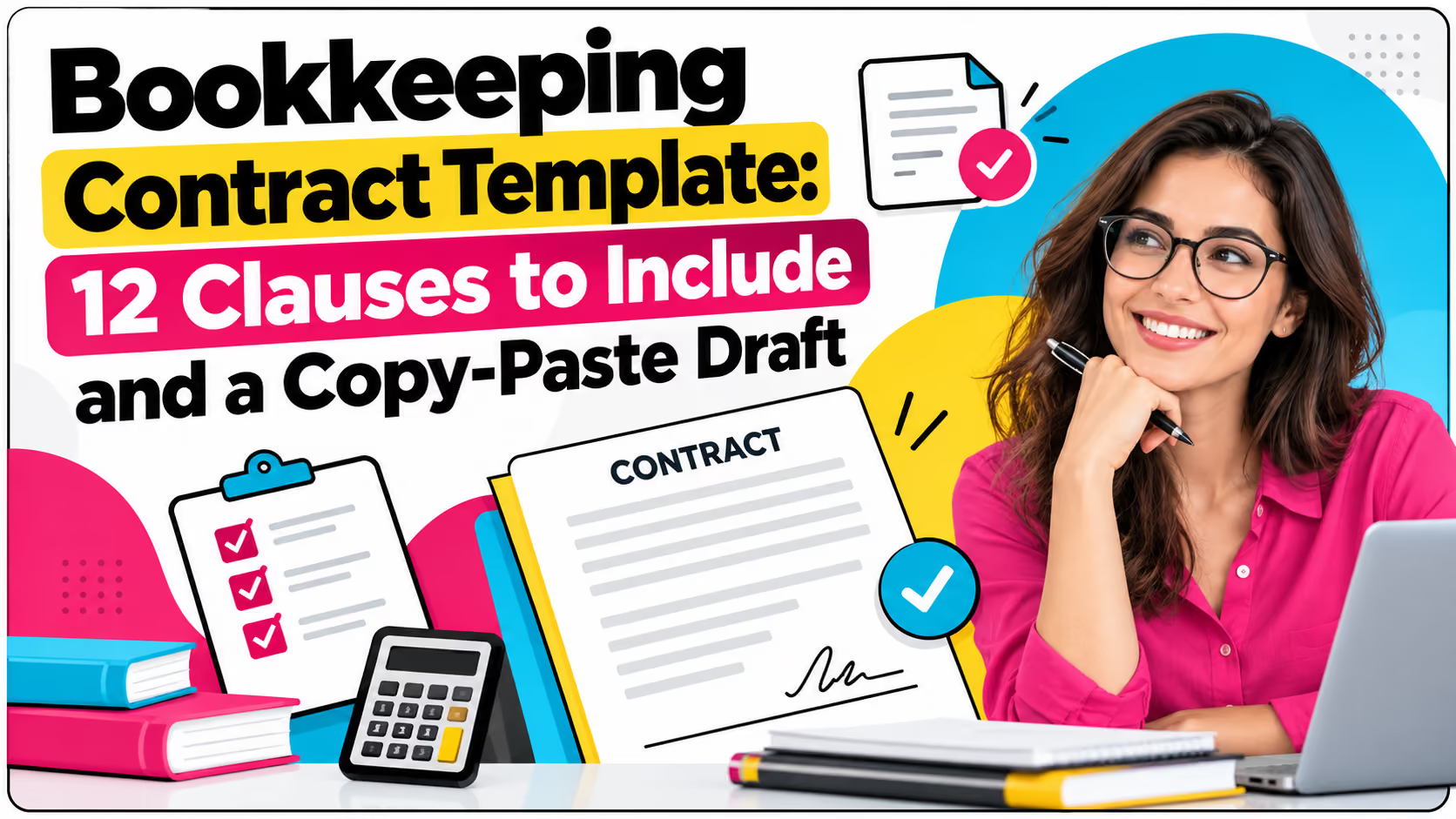
A bookkeeping contract template saves time, but only if it covers the terms that cause disputes later.
Bookkeeping disputes often start with money, access, or who owns the records. They rarely start with the bookkeeping itself.
This guide explains what a bookkeeping contract should include, gives you a copy-paste template, and shows how to fit it to each client.
It focuses on legal terms. For task-level scope, see our bookkeeping engagement letter guide.
Part of our complete guide: accounting client onboarding guide
What Is a Bookkeeping Contract?
A bookkeeping contract is a signed agreement between a bookkeeper or firm and a client. It sets the legal terms of the relationship.
You may also see it called a bookkeeping services agreement. The names overlap, and the job stays the same.
It covers payment, how either side can end the work, liability, confidentiality, and who owns the records.
Rules and enforceability differ by state. Have an attorney review your final version before you use it.
Contract vs. engagement letter vs. proposal
These three documents overlap, so firms often mix them up. Each one has a different focus.
Some firms combine all three. Others use one short contract and attach the engagement letter as an exhibit.
Attaching the letter keeps the contract stable while the scope changes. Our bookkeeping proposal template covers the proposal side.
What Should a Bookkeeping Contract Include?
A strong bookkeeping contract covers twelve clauses. Skip one and you leave room for an argument later.
Fees and payment: write them plainly
State the fee, the due date, and what happens when a payment is late. Keep cleanup fees on a separate line.
If you charge late fees or interest, check your state's limits first. Some states restrict them.
Add the right to pause work after a set number of unpaid days. That protects your time.
Term and termination: set a notice period
Say how long the contract runs and what happens at the end. If it renews on its own, say so in plain words.
Give both sides a notice period, such as 30 days. Say that the client pays for work completed through the end date.
Liability: leave the wording to an attorney
Liability and indemnity clauses carry the most legal weight. They also vary the most by state.
Use the placeholder in the template below. Have your attorney write or approve that clause before you send anything.
Data and records: keep only promises you can keep
The FTC lists tax preparation firms among the businesses its Safeguards Rule covers. Ask your attorney whether your services fall under it.
Read the FTC's Safeguards Rule guidance and the IRS's Publication 4557.
For retention, the IRS says to keep records until the period of limitations for the return runs out. See IRS Publication 583 for details.
Bookkeeping Contract Template (Copy and Paste)
Copy the text below into your document tool. Replace every item in [brackets] and delete what does not apply.
This template is general information, not legal advice. Have a licensed attorney review it for your state before you use it.
1. Parties and effective date
This agreement is between [Firm legal name] ("we") and [Client legal name] ("you"). It starts on [effective date].
2. Services
We will provide the services listed in Exhibit A, our engagement letter. Exhibit A is part of this agreement.
Services not listed in Exhibit A are not included. We will not start extra work until you approve it in writing.
3. Your responsibilities
You will give us accountant access to [QuickBooks Online] before we start. You will send all bank and card statements within [5] business days after each month ends.
You will answer our questions within [3] business days. You confirm that the information you give us is accurate and complete.
4. Fees and payment
Monthly fee: [$amount], due on the [1st] of each month. One-time cleanup fee: [$amount], due [payment terms].
If an invoice stays unpaid after [number] days, we may pause our work until you pay the balance. [Add late fee terms only if your attorney approves.]
5. Term and renewal
This agreement runs for [number] months. It then renews month to month unless either of us gives [30] days' written notice.
6. Termination
Either of us may end this agreement with [30] days' written notice. You will pay for all work we complete through the end date.
On request, we will return your records and give your new provider reasonable access within [number] business days.
7. Confidentiality
We will keep your financial information confidential. We will share it only with people who need it to do the work, or when the law requires it.
8. Data security
We will use [describe your actual safeguards, such as unique logins and multi-factor authentication]. You will not share your login credentials with anyone outside your team.
9. Records and ownership
You own your books and records. We will keep our workpapers for [number] years.
10. Limitation of liability
[Insert the limitation of liability and indemnity clauses written or approved by your attorney.]
11. Disputes and governing law
[Insert your dispute process, such as written notice, then mediation. Name the state whose law applies. Have your attorney write or approve this clause.]
12. Signatures
Firm: [name and title] ______ Date: ______
Client: [name and title] ______ Date: ______
How to Customize a Bookkeeping Contract Template for Each Client
A generic form invites disputes. Follow these steps so the contract matches the client.
Step 1: Start from the discovery call
Pull the services, accounts, and deadlines the client mentioned. Our bookkeeping discovery call checklist lists the questions to ask.
Step 2: Check the books before you set the fee
What the client says and what the file shows can differ. Our guide to running a QuickBooks diagnostic before you price a new client explains how.
Step 3: Choose the fee structure
Match the contract wording to how you charge. The table below shows what to add for each model.
Our guide to pricing bookkeeping services explains how to set each one.
Step 4: Attach the engagement letter
Attach the signed engagement letter as Exhibit A. When the scope changes, you update the exhibit and leave the contract alone.
Step 5: Get attorney review, then send it before work starts
Send the contract after the client agrees to the price and before you open their books. Hold the signed copy first.
Why Tie the Contract to a Diagnostic?
A contract protects you only as well as its scope is defined. A diagnostic gives you the facts to define it.
It names the work
Instead of a generic scope, Exhibit A lists specific findings from the client's file. The client sees what the fee covers.
It supports your change clause
If you find more issues later, you can point to the original findings. That makes a change order easier to explain.
It reduces fee disputes
A line tied to a named finding is easier to defend than a lump-sum cleanup fee. Our guide to bookkeeping scope creep shows how to price around it.
Xenett Pulse data points the same way. 68% of engagements start with unvalidated books, and scope grows 3x on average after discovery.
Xenett's guide on how to quote an accounting cleanup project covers the quoting side.
When Should You Update a Bookkeeping Contract?
Review each contract at least once a year. A signed contract can go stale even when nothing seems to have changed.
Update it when the scope changes, for example when you add payroll support, a new entity, or a new software platform.
Update it when your fees change, or when your attorney tells you a clause no longer fits your state's rules.
Record each change in writing and get both signatures again. A new signed version beats an email thread when a disagreement comes up.
Common Bookkeeping Contract Mistakes
Using a bookkeeping contract template without changing it
A sample is a starting point. Fill in your fees, your safeguards, and your state's requirements before you send it.
Leaving out a termination clause
Without notice terms, ending the work gets messy. Set a notice period for both sides.
Staying silent on who owns the records
Say that the client owns the books. Say how and when you return files after the contract ends.
Promising security you do not provide
List only the safeguards your firm actually uses. A promise you do not keep becomes a liability.
Starting work before the signature
Hold the signed copy before you open the client's books. Agree on the terms in writing first.
How Xenett Pulse Can Help
Xenett Pulse connects to the client's QuickBooks Online file with read-only access. It runs 20+ review points and builds a 9-page report in under 2 minutes.
The report includes a Books Health Score from 0 to 100, ranked risk areas, and reconciliation status for every account.
Those findings become the lines in Exhibit A. The report is white-labeled with your firm's name, so you can attach it to the contract as is.
That keeps your scope based on the file, not on what the client believes about it.
Conclusion
A bookkeeping contract works when it covers payment, termination, liability, and records in plain language. Each clause should say what happens, who does it, and by when.
Use the bookkeeping contract template above as a starting point and have an attorney review it. Then base the scope on what the client's books show, and attach the evidence.
Sign Up Free and run a diagnostic before your next contract goes out. No credit card required.
Frequently Asked Questions
What should a bookkeeping contract include?
Include the parties, scope, client duties, fees, term, termination, confidentiality, data security, record ownership, liability, disputes, and signatures. Have an attorney review the legal clauses.
Is a bookkeeping contract the same as an engagement letter?
No. The engagement letter sets the tasks, deadlines, and exclusions. The contract sets the legal terms. Many firms attach the letter to the contract.
Can I use a bookkeeping contract template without changes?
Treat a template as a starting point. Add your fees, safeguards, and state terms, and have an attorney review it before you send it.
Who owns the books in a bookkeeping contract?
The client should own the books and records. State this in the contract, and say how you return files when the work ends.
Should the contract be signed before I start work?
Yes. Hold the signed copy before you open the client's books, so terms and fees are agreed in writing.
Related guides
- Bookkeeping Mistakes That Blow Up Fixed Fees: The mistakes that blow up a fixed fee.
- What Is Xenett Pulse?: How an automated QuickBooks diagnostic tool fits the workflow.
- Catch-Up Bookkeeping Pricing: How to price cleanup work separately.