



Blog Summary
- Most bookkeeping engagements are underquoted because the scope is set before the file condition is known.
- Three pricing models: hourly, fixed fee, and value-based, each with a different use case.
- The six factors that determine cleanup pricing: backlog length, transaction volume, accounts, error severity, document availability, and immediate start pressure.
- 68% of engagements start with unvalidated books, with an average scope expansion of 3x.
- Xenett Pulse runs a pre-engagement diagnostic in under two minutes so the fee reflects the actual work.
Pricing bookkeeping services is one of the most consistently underestimated challenges in running an accounting firm.
Not because the math is hard.
Because the information needed to price accurately is not available at the time the proposal goes out.
You talk to the client.
You look at the file briefly.
You quote a monthly fee that feels reasonable.
Work starts.
The real state of the books becomes clear.
The fee you quoted does not cover the actual work.
This is the pricing problem most accounting firms face, and it is not solved by raising rates.
It is solved by knowing what is in the file before the fee is set.
This guide covers the three pricing models, the six factors that drive cleanup pricing, and how to make sure every quote reflects the actual work.
Stop Absorbing Catch-Up Overruns
Run a 20-point Xenett Pulse diagnostic in under 2 minutes and quote from evidence, not estimation.
Sign Up FreeWhy Most Bookkeeping Engagements Are Underquoted
Most bookkeeping engagements are underquoted because the scope is set on incomplete information. The client describes the books. The firm quotes based on that description. The description is almost always optimistic.
Clients do not know what is in their own books.
They know roughly how long they have been behind.
They do not know about the disconnected bank feed from four months ago.
They do not know about the 200 duplicate transactions from a CSV import.
They do not know that half their AR has unapplied payments that should have cleared eight months ago.
When the firm quotes based on the client's description, the quote reflects the client's understanding, not the actual file condition.
According to data from Xenett Pulse, 68% of engagements start with unvalidated books.
The average scope expansion after discovery is 3x.
That means the average engagement takes three times the work that was quoted.
The gap comes directly from quoting without checking the file first.
The Three Bookkeeping Pricing Models
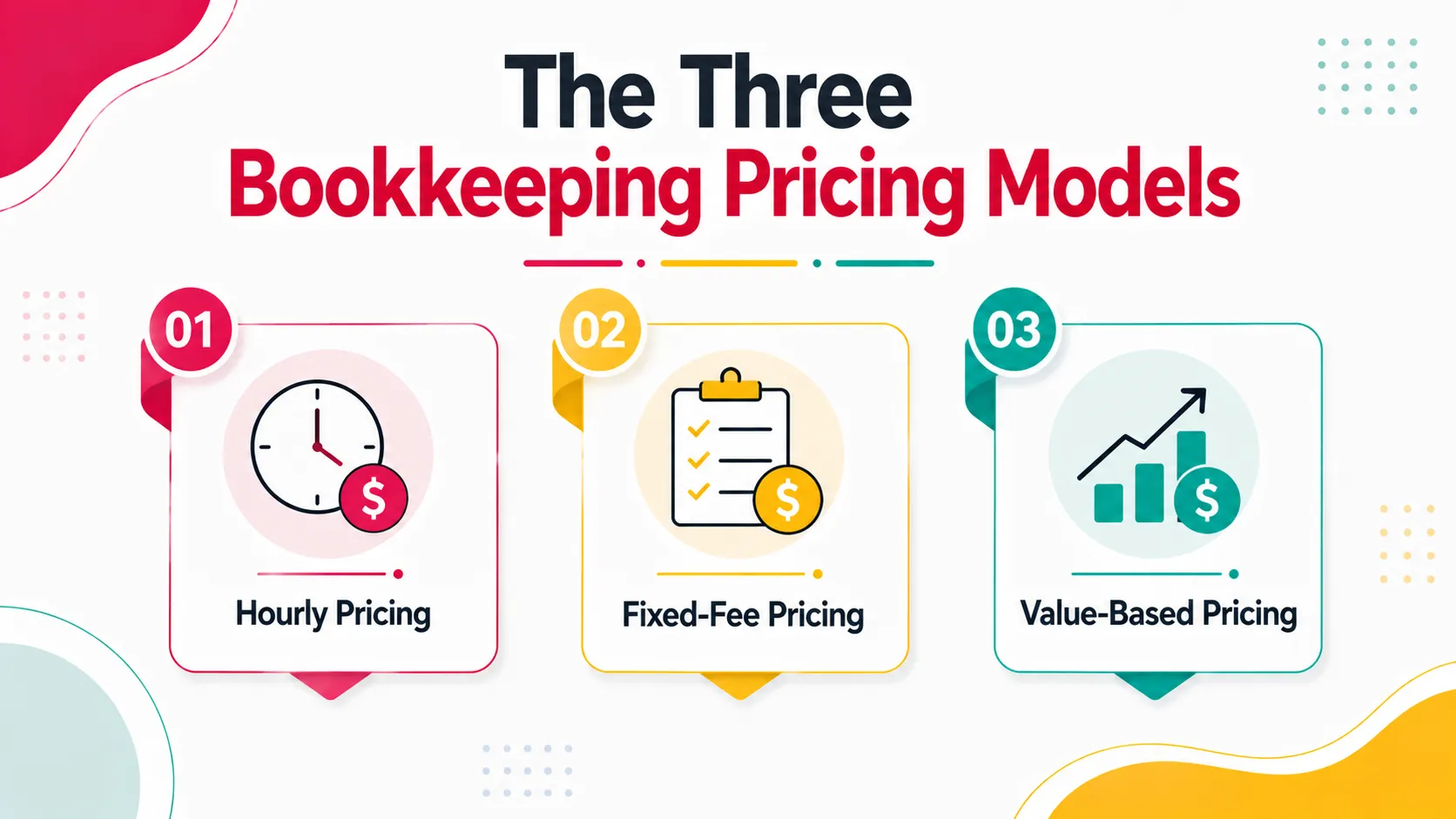
The three main pricing models for bookkeeping services are hourly, fixed fee, and value-based. Each has a specific use case.
Hourly Pricing
Bill by the hour at your standard rate.
The client pays for exactly what you do.
Your margin is fully protected.
The downside: clients want to know the total cost upfront.
Hourly pricing is harder to sell and creates anxiety for clients who cannot predict the final bill.
Best for: new client engagements where the file condition is genuinely unknown and the risk of underestimating is too high for a fixed fee.
Also appropriate for: catch-up and cleanup work where the scope will only become clear as you work through the file.
Fixed-Fee Pricing
A set monthly fee for a defined scope of services.
Clients know exactly what they will pay.
Easier to sell and easier to budget for.
The risk is entirely on the firm: if the scope expands, the fee does not.
Fixed-fee pricing only works when you know what is in the file before you set the fee.
Best for: ongoing monthly bookkeeping on clean, well-understood files.
Dangerous for: new engagements priced without a pre-engagement diagnostic.
Know What's in the File Before You Quote
Xenett Pulse surfaces every reconciliation gap, duplicate, and error in under 2 minutes.
Sign Up FreeValue-Based Pricing
Price based on the value the work delivers to the client, not the hours it takes.
A firm that saves a business $50,000 in tax exposure through accurate bookkeeping can price that service at more than the hourly equivalent.
Value-based pricing requires a deep understanding of the client's business and strong positioning.
Best for: advisory-adjacent bookkeeping where the output has clear, documentable business value beyond basic compliance.
The Six Factors That Drive Bookkeeping Cleanup Pricing
Cleanup and catch-up pricing is driven by six factors: backlog length, transaction volume, number of accounts, error severity, document availability, and whether ongoing bookkeeping needs to start immediately.
Each factor adds hours.
Most clients only know one of them: backlog length.
The other five only become visible inside the file.
| Factor | Low Complexity | High Complexity |
|---|---|---|
| Backlog Length | 1 to 3 months | 12+ months |
| Monthly Transaction Volume | Under 100 per month | 500+ per month |
| Number of Accounts | 1 to 2 bank/credit card | 5+ accounts including loans |
| Error Severity | Minor miscoding, few duplicates | Extensive duplicates, reconciliation gaps, forced entries |
| Document Availability | All statements and receipts available | Missing statements, lost receipts |
| Ongoing Start Date | Flexible | Immediate: adds pressure to the cleanup timeline |
A 12-month backlog with 500+ monthly transactions, five accounts, and significant errors is not twice the work of a 3-month clean backlog. It is ten times the work. That gap is what destroys margin on fixed-fee cleanup quotes.
Typical Bookkeeping Pricing Ranges
Typical monthly bookkeeping rates and cleanup fees vary by firm size, market, and file complexity. Use these ranges as a starting point, not a default.
Monthly Bookkeeping (Ongoing, Clean Books)
| Business Size | Typical Monthly Range |
|---|---|
| Solo/freelancer, low volume | $200 to $500 per month |
| Small business, moderate volume | $500 to $1,500 per month |
| Small business, high volume | $1,500 to $3,000 per month |
| Multi-entity or complex | $3,000+ per month |
Cleanup and Catch-Up (One-Time)
| Backlog and Complexity | Typical Range |
|---|---|
| 1 to 3 months, low complexity | $300 to $800 |
| 3 to 6 months, moderate complexity | $800 to $2,000 |
| 6 to 12 months, moderate to high complexity | $2,000 to $5,000 |
| 12+ months, high complexity | $5,000 to $15,000+ |
These are starting ranges based on current market rates. The actual fee for any engagement depends on what the diagnostic reveals about the file condition.
How to Price Accurately: The Pre-Engagement Diagnostic
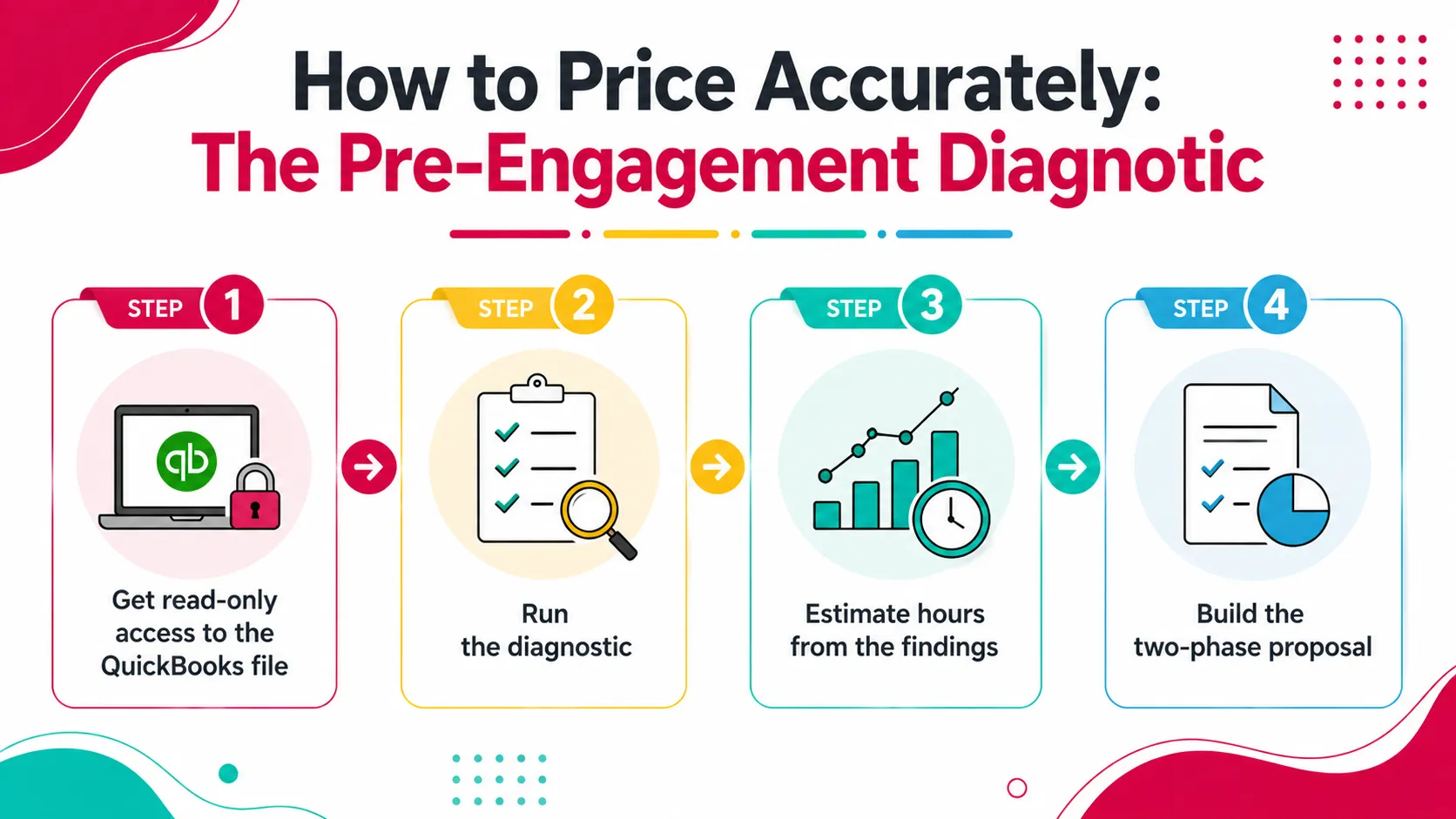
The only way to price bookkeeping services accurately is to assess the file condition before writing the proposal. A pre-engagement diagnostic turns a guess into an evidence-based quote.
Here is the process:
Step 1: Get read-only access to the QuickBooks file
Ask the client to add you as an accountant user before the proposal call. This is a standard request.
Step 2: Run the diagnostic
Xenett Pulse connects to the file and runs a 20-point diagnostic in 1 minute 42 seconds. The output surfaces all six pricing factors simultaneously:
- Reconciliation status across all accounts
- Duplicate transactions and their estimated volume
- Bank feed connectivity and gap periods
- AR and AP issues
- Transaction coding problems and anomalies
The Books Health Score (0 to 100) gives you an immediate read on overall file health. The ranked issue list tells you exactly what is wrong and how severe each problem is.
Step 3: Estimate hours from the findings
Map each finding to an estimated time:
- Stale account, 6 months: X hours to reconcile
- Duplicate transactions: X hours to identify and remove
- Disconnected feed, 3 months: X hours to re-import and match
- AR cleanup: X hours to clear
Step 4: Build the two-phase proposal
Phase 1: Cleanup fee (one-time, based on diagnostic findings). Phase 2: Ongoing monthly fee (starting from clean books).
The proposal reflects the actual work. The fee holds.
A Common Situation We See
A bookkeeping firm prices a new client at $750/month for ongoing bookkeeping.
The file looks straightforward in the summary reports.
No diagnostic is run.
The engagement starts.
The first reconciliation attempt reveals a 9-month backlog across two accounts, 180 duplicate transactions, and $12,000 in uncleared AR.
The firm spends 36 hours on cleanup before the first monthly deliverable goes out.
At $95/hour, that is $3,420 of unplanned work on a $750/month engagement.
After adding Xenett Pulse to their pre-proposal process, the same firm now runs the diagnostic on every new file before the proposal call.
The diagnostic findings from Pulse determine Phase 1.
The monthly fee starts only after Phase 1 is complete.
The firm has not had a scope overrun on a new engagement since.
Price Every Catch-Up Engagement with Confidence
Xenett Pulse gives you a documented file assessment before the proposal conversation.
How Xenett Pulse Can Help
Xenett Pulse is the tool that makes accurate bookkeeping pricing possible.
Connect the client's QuickBooks file and Pulse runs a 20-point diagnostic in 1 minute 42 seconds.
The output surfaces all six pricing factors:
- Reconciliation status for every account (current, stale, never reconciled)
- Duplicate transactions
- Bank feed gaps
- AR and AP issues
- Transaction coding problems and GPT-powered anomaly detection
The Books Health Score (0 to 100) gives you an immediate picture of overall file health.
The ranked issue list tells you exactly what the cleanup scope involves before you write a single line of the proposal.
The report is white-labelled and client-ready as a PDF, ready to share with the prospect to support your pricing conversation.
68% of engagements start with unvalidated books. Running Pulse before the proposal is what keeps your fee accurate.
Sign up free and run your first diagnostic before your next proposal goes out.
Frequently Asked Questions
How do I price bookkeeping services?
Choose a pricing model (hourly, fixed fee, or value-based), assess the file condition with a pre-engagement diagnostic, estimate hours from the findings, and build a two-phase proposal: cleanup (one-time) and ongoing (monthly). Never set a fixed fee on a file you have not assessed.
What should I charge for bookkeeping services?
Monthly rates typically range from $200 per month for low-volume solo businesses to $3,000+ per month for complex or multi-entity clients. Cleanup and catch-up fees range from $300 for a short, simple backlog to $15,000+ for a complex 12+ month cleanup.
How do I price a bookkeeping cleanup engagement?
Assess the file first using a pre-engagement diagnostic. Map each finding to an estimated time. Multiply by your hourly rate and add a complexity buffer. Present as a one-time fixed fee separate from the ongoing monthly rate.
Should I charge hourly or fixed fee for bookkeeping?
Fixed fee is easier to sell but only works when you know the file condition before setting the fee. Hourly protects your margin on unknown or complex files. The safest approach: hourly or diagnostic-based fixed fee for new clients, fixed fee for established clients with known, clean books.
How do I avoid underquoting bookkeeping engagements?
Run a pre-engagement diagnostic on every new file before writing the proposal. The diagnostic surfaces the actual scope, including cleanup work that would not be visible in a standard file review. Use the findings to price in two phases.
What factors affect bookkeeping pricing?
Six factors: backlog length, transaction volume, number of accounts, error severity, document availability, and whether cleanup is required before ongoing bookkeeping can start. Most clients only know one of these (backlog length). The other five are only visible through a file diagnostic.
How long does a pre-engagement bookkeeping diagnostic take?
Xenett Pulse runs a full 20-point diagnostic in 1 minute 42 seconds.
Conclusion
Bookkeeping pricing is not about finding the right number. It is about having the right information before you commit to any number.
The file condition determines the scope.
The scope determines the fee.
The fee holds when the scope is based on evidence.
It falls apart when the scope is based on what the client described.
Run the diagnostic before every proposal.
Price from what it surfaces.
The complete bookkeeping pricing and proposals series
Every guide below goes deeper on one part of the process covered above.
- Bookkeeping Pricing Calculator — Run your numbers with the bookkeeping pricing calculator.
- Bookkeeping Proposal Template — A bookkeeping proposal template you can download and adapt.
- Accounting Services Proposal Template — A broader accounting services proposal template for firms.
- Why Bookkeeping Scope Creep Happens — Why scope creep happens on cleanup work, and how to price around it.
- Bookkeeping Mistakes That Blow Up Fixed Fees — The bookkeeping mistakes that blow up a fixed fee.
Other guides for accounting firms
- QuickBooks Cleanup: The Complete Guide
- How to Reconcile in QuickBooks Online
- Accounting Client Onboarding Checklist
- What Is Outsourced Bookkeeping?
- QuickBooks Bookkeeping: What Clean Books Look Like
Run a free Xenett Pulse diagnostic on your next prospect file and quote from evidence, not estimation.