

Blog Summary
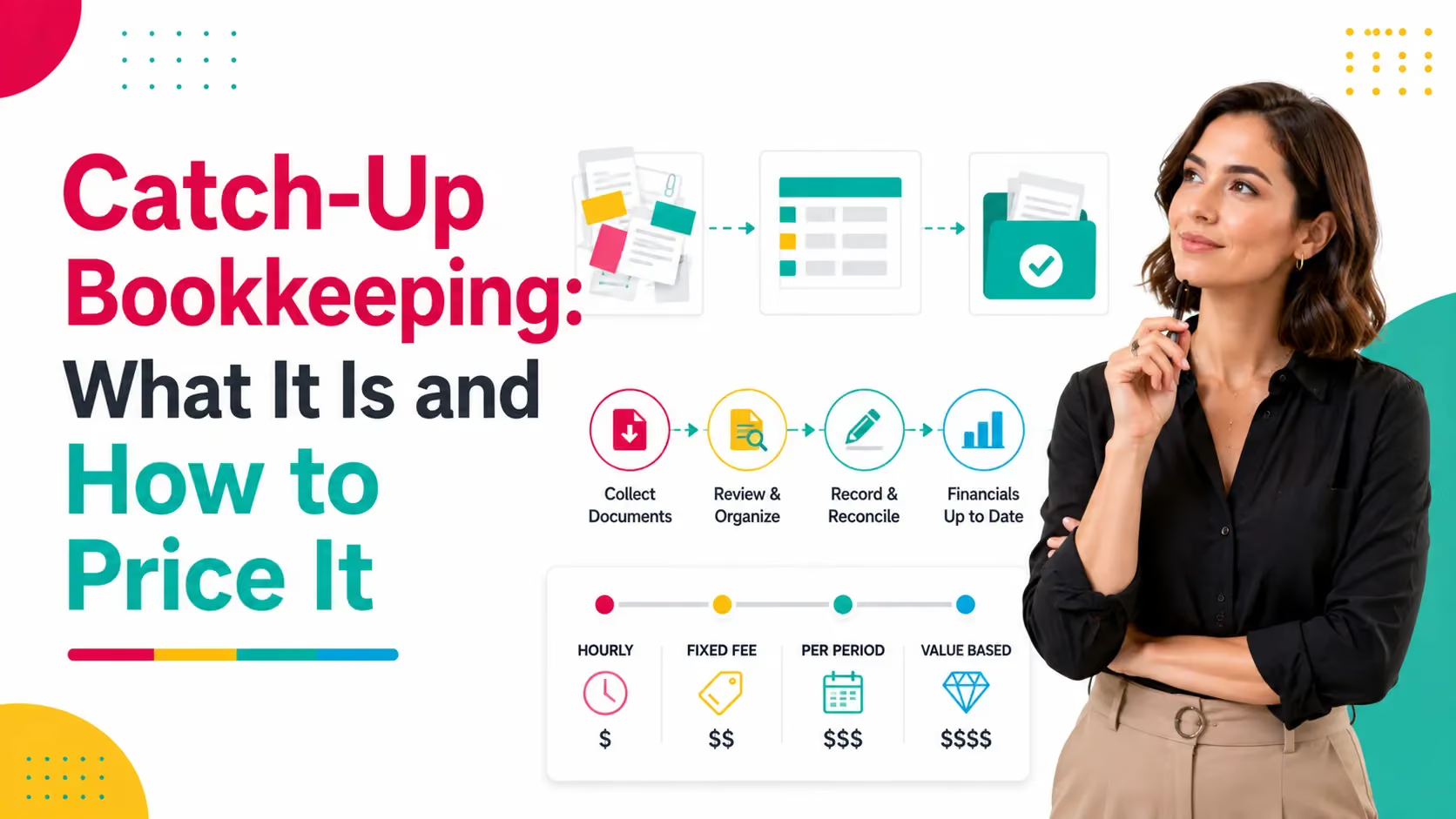
- Catch-up bookkeeping is the process of recording, categorizing, and reconciling a backlog of financial transactions that were not handled on time. It is not the same as cleanup bookkeeping, though most engagements involve both.
- The full scope of a catch-up engagement is invisible until you are inside the file. Clients cannot tell you what they do not know: disconnected bank feeds, duplicate transactions, and unreconciled balances only become visible through a diagnostic review.
- Cost is driven by six factors: backlog length, monthly transaction volume, number of accounts, error severity, document availability, and whether cleanup is also required. A 12-month high-complexity file can be five to ten times the work of a 6-month clean backlog.
- Typical pricing ranges from $300 to $800 for a 1 to 3 month low-complexity backlog, up to $5,000 to $15,000+ for 12+ months of high-complexity catch-up work.
- Fixed-fee pricing is viable, but only after a pre-engagement diagnostic. Quoting a fixed fee without assessing the file first is the most common cause of margin loss on catch-up engagements.
- A structured pre-engagement process includes getting read-only QuickBooks access, running a diagnostic, assessing the backlog per account, estimating hours by category, and building the proposal from documented findings.
- A detailed proposal specifying date ranges, accounts, error types, phases, exclusions, and an out-of-scope billing clause is the most effective way to protect scope and reduce disputes.
- Xenett Pulse runs a 20-point QuickBooks diagnostic in under two minutes, giving firms a documented basis for every catch-up quote.
A client comes in with 18 months of untouched books.
You ask a few questions.
The client says the books are "mostly fine, just need to be caught up."
You quote a cleanup fee based on what you can see.
You start the work.
Three weeks later you realize the actual transaction volume is double what you expected.
There are duplicate entries going back a year.
The bank feed disconnected eight months ago and nobody noticed.
The fee is already sent.
You absorb the rest.
This is the most common way catch-up bookkeeping engagements go wrong, not because the work is hard, but because the scope was set before anyone knew what was actually in the file.
This guide covers what catch-up bookkeeping is, what drives the cost, how to price it accurately, and how to protect your firm before the engagement letter goes out.
Part of our complete guide: complete QuickBooks cleanup guide
What Is Catch-Up Bookkeeping?
Catch-up bookkeeping is the process of recording, categorizing, and reconciling a backlog of financial transactions that were not handled on time.
It applies when a business has fallen behind on its books: anywhere from a few months to several years.
The goal is to bring the books current so the business has accurate financial records for tax filing, loan applications, investor reporting, or simply knowing where they stand.
Catch-up bookkeeping is not the same as cleanup bookkeeping, though the two often overlap.
Here is the difference:
| Type | What It Means | Who Needs It | Typical Timeline |
|---|---|---|---|
| Catch-Up Bookkeeping | Recording transactions that were never entered | Businesses with a backlog of unrecorded activity | 1 week to 3 months depending on backlog size |
| Cleanup Bookkeeping | Correcting transactions that were entered incorrectly | Businesses with miscoded, duplicate, or unreconciled entries | 2 weeks to 6 months depending on severity |
| Ongoing Bookkeeping | Maintaining current, accurate records month to month | Any business with regular financial activity | Continuous |
In practice, most catch-up engagements involve both.
A business that has not touched its books in 18 months will have missing transactions and bad ones.
You are recording what was never entered and fixing what was entered wrong, at the same time.
That is why scoping these engagements accurately matters so much.
Stop Absorbing Catch-Up Overruns
Run a 20-point Xenett Pulse diagnostic in under 2 minutes and quote from evidence, not estimation.
Sign Up FreeWhy Catch-Up Bookkeeping Is Hard to Price
Catch-up bookkeeping is hard to price because the full scope is invisible until you are inside the file.
Most firms price based on what the client tells them.
The client says "about 12 months of backlog."
The client says "we have most of the bank statements."
The client says "the books are pretty clean, just not current."
None of that is reliable.
Clients do not know what is in their own books.
They cannot see duplicate transactions.
They do not know their bank feed disconnected six months ago.
They do not realize their AR has $40,000 in unapplied payments sitting unreconciled.
The standard QuickBooks summary reports do not surface any of this.
They show what the numbers say, not what is wrong with the underlying data.
This is why firms that price catch-up engagements on a fixed fee, without a pre-engagement diagnostic, consistently underquote.
They are pricing based on what the client believes is true, not what the file actually contains.
According to Intuit's research on small business financial health, a large share of small business QuickBooks files contain classification errors and reconciliation gaps that go undetected for months.
The errors accumulate silently.
They only become visible when someone goes looking for them, which usually happens after the engagement has started and the fee is locked.
Know What's in the File Before You Quote
Xenett Pulse surfaces every reconciliation gap, duplicate, and error in under 2 minutes.
Sign Up FreeWhat Affects the Cost of Catch-Up Bookkeeping?
The cost of catch-up bookkeeping is driven by six factors: backlog length, transaction volume, number of accounts, error severity, document availability, and whether cleanup is also required.
Each factor adds time.
Most clients only know one of them: the backlog length.
The rest only become visible inside the file.
Here is how each factor affects scope:
| Pricing Factor | Low Complexity | High Complexity |
|---|---|---|
| Backlog Length | 1 to 6 months | 12+ months |
| Monthly Transaction Volume | Under 100 transactions/month | 500+ transactions/month |
| Number of Accounts | 1 to 2 bank/credit card accounts | 5+ accounts including loans and payroll |
| Error Severity | Minor miscoding, few duplicates | Extensive duplicates, disconnected feeds, reconciliation gaps |
| Document Availability | All bank statements and receipts available | Missing statements, lost receipts, no source docs |
| Cleanup Required | Minimal, mostly entry work | Significant, corrections required throughout |
Proposal Element
A 12-month backlog with high transaction volume, five accounts, and significant errors is not twice the work of a 6-month clean backlog.
It can be five to ten times the work.
That gap is what destroys margin on fixed-fee catch-up engagements.
How to Price a Catch-Up Bookkeeping Engagement
Price catch-up bookkeeping based on documented file condition, not client description. Use a pre-engagement diagnostic to assess all six pricing factors before setting a fee.
There are two common pricing models:
Hourly pricing
Bill by the hour at your standard rate.
Protects your margin completely.
Harder to sell: clients want to know what they will pay before they commit.
Best for engagements where the file condition is genuinely unknown and the risk of underestimating is high.
Fixed-fee pricing
Client knows the total cost upfront.
Easier to sell and easier to scope into a proposal.
Only works if you know what is in the file before you set the fee.
If you quote fixed fee without a diagnostic, you are absorbing any scope you missed.
The right approach for most firms is fixed-fee pricing, but only after a pre-engagement diagnostic.
Here is what typical catch-up bookkeeping engagements cost in the current market, based on AccountingToday's firm pricing benchmarks:
- 1 to 3 months backlog, low complexity: $300 to $800
- 3 to 6 months backlog, moderate complexity: $800 to $2,000
- 6 to 12 months backlog, moderate to high complexity: $2,000 to $5,000
- 12+ months backlog, high complexity: $5,000 to $15,000+
These are starting ranges.
The actual fee for any engagement depends on your market, your hourly rate, and what the diagnostic reveals.
A Common Situation We See
A bookkeeping firm takes on a new restaurant client with a 14-month backlog.
The client describes the books as "behind but not messy."
The firm quotes $2,400 fixed fee based on the backlog length and a brief file review.
Work starts.
Inside the file: three disconnected bank feeds, over 600 duplicate transactions from a manual import, and an AR balance that has not been reconciled in 11 months.
The actual work takes 47 hours at their standard rate, nearly three times the quoted fee.
They deliver the work.
They absorb the difference.
After adding a pre-engagement diagnostic to their process, the same firm now runs a full file assessment before every catch-up quote.
The diagnostic surfaces all six pricing factors in under two minutes.
The fee reflects the actual work.
The margin holds.
Price Every Catch-Up Engagement with Confidence
Xenett Pulse gives you a documented file assessment before the proposal conversation.
How to Scope Catch-Up Bookkeeping Before You Quote
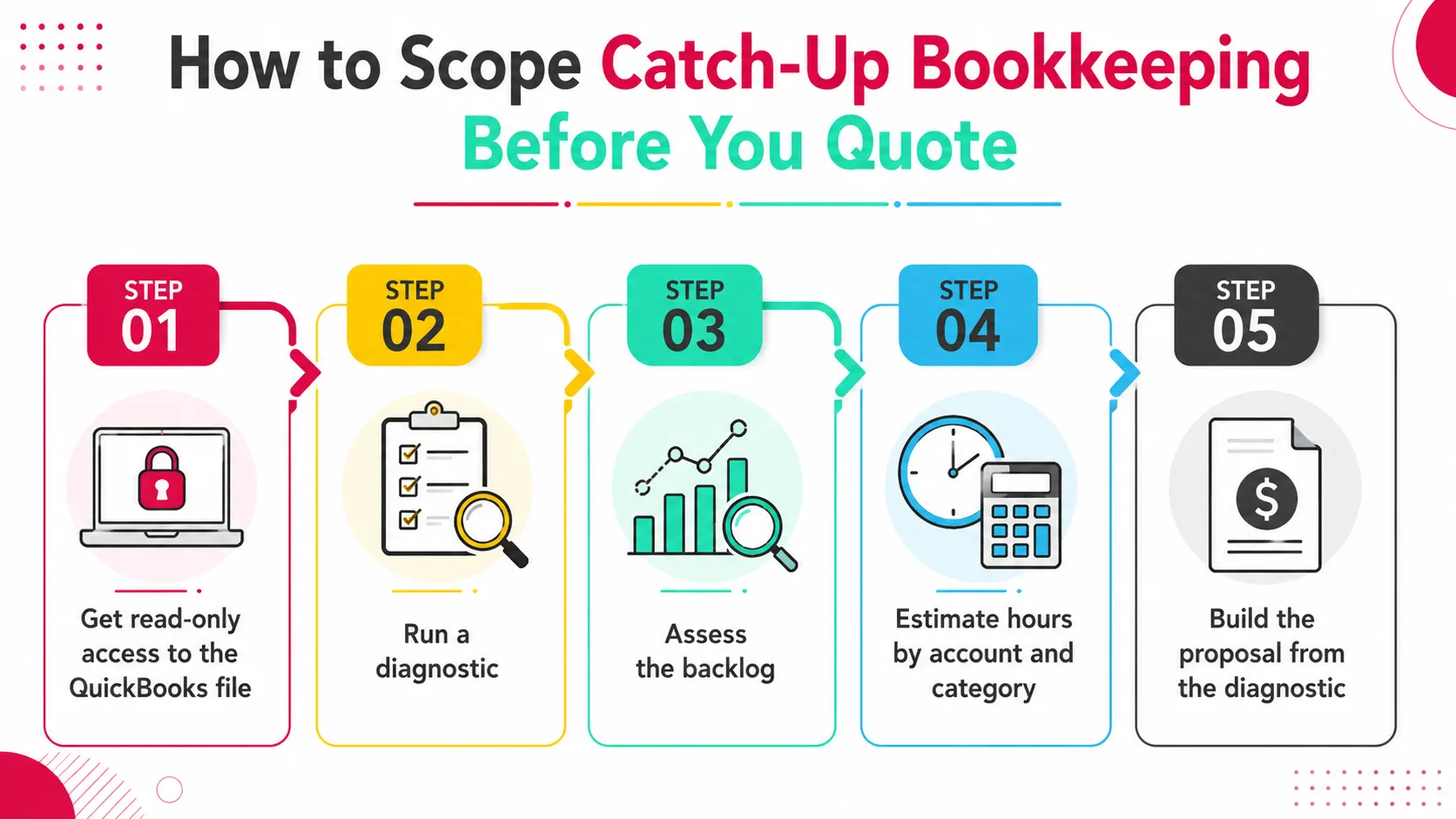
Scope a catch-up engagement by assessing the file condition across all six pricing factors before writing a proposal. Do this before the client call, not during it.
Here is a practical pre-engagement scoping process:
Step 1: Get read-only access to the QuickBooks file
Ask the client to add you as an accountant user before the proposal call.
This is a standard request: most clients comply without hesitation.
Step 2: Run a diagnostic
Use Xenett Pulse to run a 20-point diagnostic on the file.
The scan takes under two minutes and surfaces all reconciliation gaps, duplicate transactions, disconnected bank feeds, AR and AP issues, and coding errors, ranked by severity.
You now have a documented picture of all six pricing factors.
Step 3: Assess the backlog
Look at the date of the last reconciliation across all accounts.
Note the number of unreconciled months per account, not just the overall backlog.
A file with five accounts where two are 18 months behind and three are current is a different engagement than a file where all five are 14 months behind.
Step 4: Estimate hours by account and category
Use the diagnostic output to estimate hours by task category:
- Transaction entry and categorization
- Reconciliation per account per month
- Duplicate cleanup
- AR and AP correction
- Journal entry review
Step 5: Build the proposal from the diagnostic
Your scope section should list exactly what you found and exactly what you will fix.
Not "catch up the books."
"Reconcile accounts X, Y, Z from [start date] through [end date]. Remove [X] duplicate transactions. Correct miscoded expenses in [categories]. Reconnect and reconcile bank feed for [account]."
That level of specificity protects your scope, supports your fee, and gives the client confidence that you know what you are doing.
For more on writing the proposal document itself, see our guide on how to write a bookkeeping engagement letter.
What to Include in Your Catch-Up Bookkeeping Proposal
A catch-up bookkeeping proposal should include: the date range in scope, a list of accounts being addressed, specific error types being corrected, a phase or milestone structure for large backlogs, exclusions, and an out-of-scope billing clause.
For large backlogs, anything over six months, consider structuring the work in phases.
- Phase 1: Most recent 6 months
- Phase 2: Prior 6 months
- Phase 3: Remaining backlog
This approach gives the client a clearer picture of progress, lets you invoice in milestones, and reduces your exposure if the engagement expands.
Here is a proposal checklist:
| Proposal Element | Include? | Notes |
|---|---|---|
| Date range in scope | Yes | Specific start and end date per account |
| List of accounts | Yes | Every bank, credit card, loan account being addressed |
| Error types in scope | Yes | Duplicates, miscoding, reconciliation gaps, whatever the diagnostic found |
| Phase structure | Recommended for 6+ month backlogs | Helps with invoicing and scope control |
| Exclusions | Yes | Tax prep, payroll, advisory, anything outside the cleanup scope |
| Out-of-scope billing rate | Yes | Hourly rate for work beyond defined scope |
| Client responsibilities | Yes | Bank statements, receipts, access to accounts |
| Estimated completion date | Yes | Based on your hours estimate and availability |
| Total fee or phase fees | Yes | Fixed fee per phase or total fixed fee with milestone billing |
The more specific the proposal, the fewer scope disputes later.
How Xenett Can Help
Pricing catch-up bookkeeping accurately starts with knowing what is in the file.
Xenett Pulse runs a 20-point QuickBooks diagnostic in under two minutes and surfaces every issue that affects your scope: reconciliation gaps, duplicate transactions, disconnected bank feeds, AR and AP problems, and coding errors, ranked by severity.
That diagnostic output becomes your pricing document.
You walk into the proposal conversation with a complete picture of the work, not an estimate based on what the client told you, but a documented assessment of what the file actually contains.
Once the catch-up work starts, Xenett's accounting workflow management keeps everything organized: task assignments, preparer and reviewer workflows, deadline tracking, and a centralized view of every open item across your client portfolio.
For firms doing ongoing bookkeeping after the catch-up is complete, Xenett's auto review runs 100+ automated checks on every file, catching errors before they accumulate into the next backlog.
Firms using Xenett report 70% less review time and a 3x faster close process.
That efficiency starts at the pre-engagement stage, before the first transaction is touched.
Start your free trial and run your first Pulse diagnostic before your next catch-up quote.
Or book a 15-minute demo to see how Pulse fits into your current pricing process.
Frequently Asked Questions
What is catch-up bookkeeping?
Catch-up bookkeeping is the process of recording, categorizing, and reconciling financial transactions that were not handled on time.
It applies when a business has fallen behind on its books, from a few months to several years, and needs to bring its records current.
Most catch-up engagements also involve cleanup work: correcting errors, removing duplicates, and resolving reconciliation gaps in existing entries.
How long does catch-up bookkeeping take?
It depends on the backlog length, transaction volume, number of accounts, and severity of errors in the file.
A 3-month backlog with low transaction volume and clean data might take 5 to 10 hours.
A 12-month backlog with high volume, multiple accounts, and significant errors can take 40 to 80+ hours.
A pre-engagement diagnostic, run through a tool like Xenett Pulse, gives you an accurate hours estimate before work starts.
How much does catch-up bookkeeping cost?
Typical ranges based on current market rates:
- 1 to 3 months backlog, low complexity: $300 to $800
- 3 to 6 months backlog, moderate complexity: $800 to $2,000
- 6 to 12 months backlog, moderate to high complexity: $2,000 to $5,000
- 12+ months backlog, high complexity: $5,000 to $15,000+
The actual fee depends on your firm's hourly rate, the file condition, and how the engagement is structured.
Always assess the file before quoting a fixed fee.
What is the difference between catch-up and cleanup bookkeeping?
Catch-up bookkeeping means recording transactions that were never entered.
Cleanup bookkeeping means correcting transactions that were entered incorrectly: duplicates, miscoding, unreconciled accounts, unapplied payments.
Most engagements involve both.
A business that has not touched its books in over a year will have missing entries and bad ones.
Can I do catch-up bookkeeping myself in QuickBooks?
Yes, if the backlog is short and the file is relatively clean.
For a backlog of 1 to 3 months with low transaction volume and no significant errors, a business owner with basic QuickBooks knowledge can often handle it.
For anything longer, more complex, or with significant errors, working with an accounting professional is faster, more accurate, and less likely to introduce new problems.
The AICPA's guidance on bookkeeping engagements recommends professional involvement for any catch-up work that will be used for tax filing or financial reporting.
What do I need to provide my accountant for catch-up bookkeeping?
At minimum: access to your QuickBooks file, bank statements for every account in the backlog period, and credit card statements if applicable.
For more complex engagements: receipts or invoices for large transactions, payroll records if payroll is being categorized, and any loan or line of credit statements.
The more complete the documentation, the faster and more accurate the catch-up work.
How far back can catch-up bookkeeping go?
There is no technical limit.
Accountants regularly handle backlogs of two to five years, and occasionally longer for businesses that have never maintained formal records.
That said, the further back the backlog goes, the harder it is to find source documents and verify transactions.
For tax purposes, the IRS recommends keeping financial records for at least three years, so prioritize accuracy for any period that falls within that window.
Catch-Up Bookkeeping: At a Glance
| Element | Detail |
|---|---|
| What it is | Recording, categorizing, and reconciling a backlog of financial transactions |
| Who needs it | Businesses behind on their books: new clients, lapsed clients, tax prep prep |
| What drives cost | Backlog length, transaction volume, accounts, error severity, document availability |
| How to price it | Run a pre-engagement diagnostic, then quote fixed fee or hourly based on findings |
| Biggest pricing risk | Fixed-fee quote without knowing the file condition |
| How to protect scope | Detailed proposal: date range, accounts, error types, exclusions, out-of-scope clause |
| Best tool for pre-engagement assessment | Xenett Pulse: 20-point QuickBooks diagnostic in under 2 minutes |
The client who says their books are "mostly fine" is not lying.
They genuinely do not know what is in there.
That is your job to find out, before the fee is set, not after.
Run a free Xenett Pulse diagnostic on your next catch-up prospect file and quote from evidence, not estimation.
Related guides
- Start here: QuickBooks Cleanup: The Complete Guide
- Adjusted Trial Balance Explained — How to prepare the adjusted trial balance that closes out a cleanup.
- True Up in Accounting — What a true-up entry is and when a cleanup calls for one.
- QuickBooks Online Cleanup Checklist — The step-by-step checklist to work through a QBO cleanup in order.