



Blog Summary
- Outsourced bookkeeping means hiring an external accounting firm or bookkeeper to manage a business's financial records instead of handling them in-house.
- The main benefits: cost savings, access to experienced bookkeepers, scalability, and accurate monthly reporting without hiring staff.
- The main risk: taking on a client file without knowing its actual condition, leading to scope overruns on fixed-fee engagements.
- 68% of outsourced bookkeeping engagements start with unvalidated books. The average scope expansion is 3x.
- Xenett Pulse runs a 20-point QuickBooks diagnostic in 1 minute 42 seconds before the engagement starts.
- Pricing ranges from $200 to $3,000 per month depending on transaction volume and complexity.
A business owner is spending four hours every Sunday catching up on bookkeeping. Or they hired someone internally who left, and the books have not been touched in three months. Or they are preparing for a loan application and realize the financial records are not in a state they can hand to a bank.
In all three cases, the answer is often the same: outsource the bookkeeping.
Outsourced bookkeeping is one of the most common services accounting firms offer. It is also one of the most commonly underpriced. This guide covers what outsourced bookkeeping is, how it works, what it costs, and what both business owners and accounting firms need to know before starting an outsourced engagement.
What Is Outsourced Bookkeeping?
Outsourced bookkeeping is the practice of hiring an external firm or professional bookkeeper to manage a business's financial records, rather than maintaining an in-house bookkeeping function. Instead of a full-time or part-time employee handling the books, an external firm takes responsibility for:
- Recording and categorizing transactions
- Reconciling bank and credit card accounts
- Managing accounts receivable and accounts payable
- Preparing monthly financial statements
- Maintaining clean, accurate records for tax preparation and reporting
The business retains access to its own QuickBooks file. The outsourced bookkeeper works within that file on an agreed schedule. Monthly deliverables are defined in the engagement letter.
Outsourced Bookkeeping vs In-House Bookkeeping
The main difference between outsourced and in-house bookkeeping is who manages the function, what it costs, and how the risk is distributed.
For most small businesses with under $5 million in annual revenue, outsourced bookkeeping is significantly more cost-effective than an in-house hire. The break-even point varies by market, transaction volume, and complexity.
What Does Outsourced Bookkeeping Include?
Outsourced bookkeeping typically includes monthly transaction categorization, bank and credit card reconciliation, AR and AP management, and delivery of a monthly financial package. What is included varies by engagement: always check the engagement letter.
Standard inclusions:
- Recording and categorizing all transactions
- Reconciling all bank and credit card accounts monthly
- Preparing monthly profit and loss statement and balance sheet
- Reviewing AR aging and following up on outstanding invoices (if in scope)
- Managing AP and processing bill payments (if in scope)
- Delivering monthly financial package by an agreed date
Common exclusions (unless specifically agreed): tax preparation and filing, payroll processing, CFO or financial advisory services, and historical cleanup of prior periods. The scope of what is included should be documented in a signed engagement letter before work begins. For guidance on what to include, see our post on the engagement letter for accounting services.
How Much Does Outsourced Bookkeeping Cost?
Outsourced bookkeeping costs between $200 and $3,000 per month for most small businesses, depending on transaction volume, number of accounts, and complexity. Pricing is typically structured as a fixed monthly fee (a set fee for a defined scope, predictable for the client but carrying margin risk for the firm if scope is not based on actual file condition) or hourly billing (billed at an hourly rate for actual time spent, protects firm margin but less predictable for the client).
These ranges apply to ongoing monthly bookkeeping on clean files. If the file requires cleanup before ongoing bookkeeping can begin, a one-time cleanup fee is typically charged separately. That cleanup fee can range from $500 for a minor backlog to $15,000 or more for a complex multi-year cleanup. For guidance on pricing, see our post on how to price bookkeeping services.
How Outsourced Bookkeeping Works: Step by Step
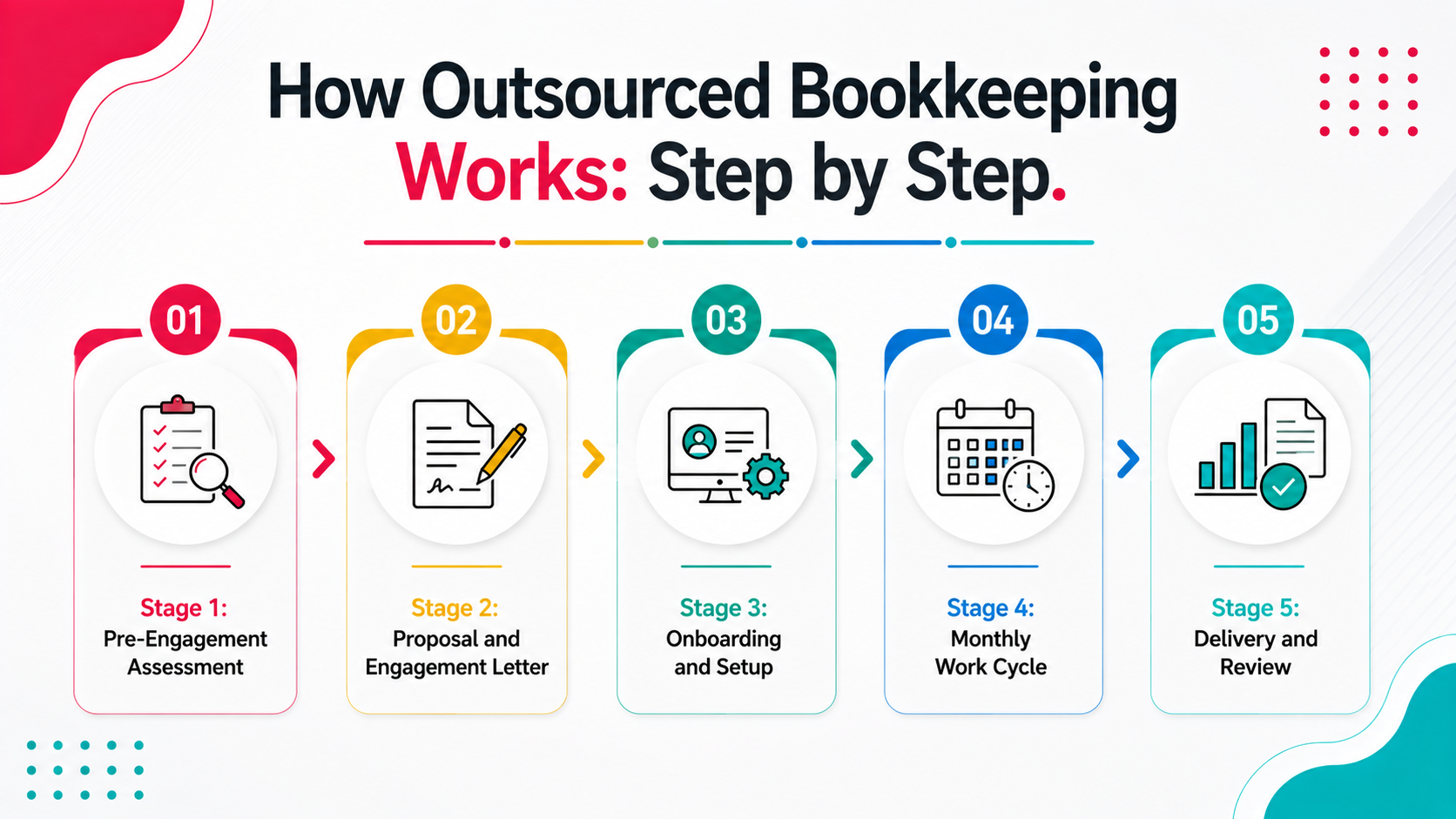
Outsourced bookkeeping works through five stages: pre-engagement assessment, proposal and engagement letter, onboarding and setup, monthly work cycle, and delivery and review.
Stage 1: Pre-Engagement Assessment
Before the proposal goes out, the outsourced bookkeeper assesses the current state of the client's books. This is the step most firms skip and the one that causes the most problems.
Xenett Pulse connects to the client's QuickBooks file and runs a 20-point diagnostic in 1 minute 42 seconds. The output is a Books Health Score (0 to 100) and a ranked list of every issue across banking, AR, AP, reconciliations, and coding. 68% of outsourced bookkeeping engagements start with unvalidated books. The average scope expansion after discovery is 3x. The diagnostic before the proposal is what prevents that expansion from happening on a fixed fee.
Stage 2: Proposal and Engagement Letter
The proposal outlines the scope, fee, and timeline based on the diagnostic findings. If the file needs cleanup before ongoing bookkeeping can begin, the proposal includes a Phase 1 cleanup fee and a Phase 2 ongoing monthly fee. The engagement letter is signed before work begins. For guidance, see our post on the bookkeeping proposal template.
Stage 3: Onboarding and Setup
The client provides QuickBooks access, bank statements, and any prior year records needed. The bookkeeper sets up the workflow, assigns tasks, and configures recurring monthly processes. The kickoff call confirms scope, deliverables, and the first delivery date. For the full onboarding checklist, see our post on the bookkeeping new client checklist.
Stage 4: Monthly Work Cycle
Each month the bookkeeper reviews the bank feed and categorizes transactions, reconciles all bank and credit card accounts, reviews AR and AP, and prepares the monthly financial package.
Stage 5: Delivery and Review
The financial package is delivered by the agreed date. The client reviews. Any questions or clarifications are handled before the next cycle begins.
What to Look for in an Outsourced Bookkeeping Firm
When evaluating an outsourced bookkeeping firm, look for four things: a documented pre-engagement process, a clear engagement letter, defined monthly deliverables, and QuickBooks expertise.
The pre-engagement diagnostic is the clearest signal of a firm that knows what it is doing. A firm that assesses the file before quoting has a professional process. A firm that quotes from a 15-minute call is guessing.
QuickBooks expertise matters just as much on the staffing side of an outsourced engagement, not just the software side. If you are evaluating a dedicated bookkeeping partner rather than a diagnostic tool, Etisson's breakdown of the CPA firm software stack covers which platforms a staff member needs to be proficient in before you commit to an engagement.
A Common Situation We See
A small e-commerce business decides to outsource their bookkeeping. They find a firm online. The firm quotes $650 per month based on a brief call and a look at the QBO dashboard. Work starts. Month one goes smoothly. Month two: the firm finds a Shopify integration that has been importing duplicate transactions for eight months. The AR aging shows $18,000 in unapplied payments. Two bank accounts have not been reconciled since January. The $650 per month fee covers none of this cleanup work. The firm either absorbs it or has an uncomfortable conversation about additional billing.
After implementing Xenett Pulse as part of their pre-engagement process, the same firm now runs the diagnostic before every proposal call. The diagnostic findings from Pulse determine the Phase 1 cleanup scope. The monthly fee starts only after Phase 1 is complete. Every engagement since has come in within 10 percent of the quoted fee.
Stop Absorbing Catch-Up Overruns
Run a 20-point Xenett Pulse diagnostic in under 2 minutes and quote from evidence, not estimation.
Sign Up FreeHow Xenett Pulse Helps Outsourced Bookkeeping Firms
Xenett Pulse is the pre-engagement diagnostic tool built for outsourced bookkeeping firms. Connect the client's QuickBooks file and Pulse runs a 20-point diagnostic in 1 minute 42 seconds. The output covers reconciliation status for every account, banking issues (duplicate transactions, disconnected feeds, cash discrepancies), AR (unapplied payments, stale open invoices, duplicate customer records), AP (unapplied credits, past-due bills, duplicate vendor records), and transaction coding (miscoded expenses, missing classifications, GPT-powered anomaly detection).
The Books Health Score (0 to 100) gives an immediate picture of file health. The ranked issue list tells you exactly what needs to be fixed before the monthly cycle can begin. The report is white-labelled and client-ready as a PDF from day one. 68% of engagements start with unvalidated books. Running Pulse before the proposal puts your firm in the other 32%.
Sign up free and run your first diagnostic before your next outsourced bookkeeping proposal. Or download a sample report to see what the output looks like.
Outsourced Bookkeeping: At a Glance
Frequently Asked Questions
What is outsourced bookkeeping?
Outsourced bookkeeping is the practice of hiring an external firm or professional bookkeeper to manage a business's financial records instead of maintaining an in-house bookkeeping function. It typically includes monthly transaction categorization, bank reconciliation, AR and AP management, and monthly financial reporting.
How much does outsourced bookkeeping cost?
Monthly fees typically range from $200 for low-volume solo businesses to $3,000 or more for complex or high-volume clients. If the books require cleanup before ongoing bookkeeping can begin, a one-time cleanup fee is charged separately, ranging from $500 to $15,000 or more depending on complexity.
What is included in outsourced bookkeeping services?
Standard inclusions: transaction categorization, bank and credit card reconciliation, AR and AP review, and monthly financial statements. Common exclusions: tax preparation, payroll, advisory services, and historical cleanup. Always confirm the scope in a signed engagement letter before work begins.
How do I choose an outsourced bookkeeping firm?
Look for a firm that runs a pre-engagement diagnostic before quoting, uses a signed engagement letter with a specific scope, delivers a defined monthly financial package, and has documented QuickBooks Online expertise.
What is the difference between outsourced bookkeeping and a bookkeeper employee?
An outsourced bookkeeper is an external firm or contractor paid a monthly fee. An employee bookkeeper is a staff member paid a salary with benefits and payroll taxes. For most small businesses, outsourced bookkeeping costs significantly less than an employee and provides access to a team with broader expertise.
How long does it take to set up outsourced bookkeeping?
Onboarding typically takes three to seven business days from signed engagement letter to the first active workflow. If the file requires cleanup first, add the time needed to complete Phase 1 before the monthly cycle begins.
Do I need to clean up my books before outsourcing bookkeeping?
Not necessarily, but the outsourced firm should assess the file before quoting. If the file has significant issues, a Phase 1 cleanup is typically included in the engagement before ongoing bookkeeping begins. A pre-engagement diagnostic like Xenett Pulse surfaces all issues in under 2 minutes so the scope and fee are accurate from day one.
The complete outsourced bookkeeping and advisory series
Every guide below goes deeper on one part of the process covered above.
- Accounting Advisory Services - What advisory services are and how to start offering them.
- Bench vs Pilot vs QuickBooks Live - How Bench, Pilot and QuickBooks Live compare on cost.
- Will AI Replace Accountants? - What the data says about AI and the accounting profession.