


Blog Summary
- Bench, Pilot, and QuickBooks Live all use tiered pricing that scales with revenue or transaction volume, not a single flat rate.
- Pilot generally costs more but includes more advisory-level service. Bench and QuickBooks Live are positioned closer to pure bookkeeping.
- None of these three typically includes cleanup work in their base ongoing rate, cleanup is usually quoted and billed separately.
- The right choice depends less on price alone and more on how much advisory support your business actually needs versus straightforward transaction recording.
- Getting an accurate cost comparison requires knowing your actual monthly expenses or transaction volume, not just picking a service off its advertised starting price.
Introduction
Comparing bookkeeping providers by their advertised starting price is close to useless, since almost none of them charge that price for very long.
Bench, Pilot, and QuickBooks Live all publish a starting rate that applies to a narrow band of very simple businesses. The moment your transaction volume, number of accounts, or revenue crosses a threshold, which happens quickly for most real businesses, the price moves, sometimes substantially.
This guide compares what each of these three options actually costs once you account for how their pricing really scales, what is and is not included at each tier, and where the real trade-offs are beyond the sticker price.
Part of our complete guide: outsourced bookkeeping guide
How Each Provider Actually Prices Its Service
Each of these three providers uses a different pricing mechanism, which makes direct comparison harder than it first appears.
1. Bench
Bench prices primarily based on your average monthly expenses, with plans that scale up as that number increases. It positions itself as bookkeeping-first, with tax and advisory services available as add-ons rather than built into the core plan.
2. Pilot
Pilot prices based on monthly expenses as well, but its plans are structured around bundling bookkeeping with more advisory-level services, which shows up in a meaningfully higher price point at every tier compared to Bench.
3. QuickBooks Live
QuickBooks Live prices based on monthly expenses as well, and is positioned as an add-on to QuickBooks Online rather than a fully independent bookkeeping service, which affects what is and is not included compared to the other two.
All three of these pricing models mean your cost is not fixed once you sign up. If your business grows, your monthly expenses cross into the next tier, and your bill increases automatically at the next billing cycle.
What's Included at Each Price Point
| Bench | Pilot | QuickBooks Live | |
|---|---|---|---|
| Core bookkeeping | Included | Included | Included |
| Dedicated bookkeeper | Included at most tiers | Included | Varies by tier |
| Tax filing | Add-on, separate service | Add-on, separate service | Not included, separate TurboTax integration |
| CFO or advisory services | Not included at base tiers | Included at higher tiers | Not included |
| Catch-up or cleanup work | Separate, additional cost | Separate, additional cost | Separate, additional cost |
| Software cost | Bench's own platform | Pilot's own platform | Requires QuickBooks Online subscription |
| Best fit | Simple, straightforward bookkeeping needs | Businesses wanting advisory support bundled in | Businesses already on QuickBooks Online wanting an official add-on |
Side-by-Side Cost Comparison
Exact pricing tiers change over time and are based on your monthly expenses, so treat the ranges below as a general shape of how each provider scales rather than a locked-in quote. Check each provider's current pricing page for exact numbers.
| Monthly Expense Range | Bench (approximate) | Pilot (approximate) | QuickBooks Live (approximate) |
|---|---|---|---|
| Under $10,000 | Lower tier pricing | Meaningfully higher than Bench at the same tier | Comparable to or below Bench, plus required QBO subscription |
| $10,000 to $30,000 | Mid tier pricing | Noticeably higher, reflecting bundled advisory | Scales up, still requires separate QBO subscription |
| Over $30,000 | Higher tier, custom pricing may apply | Highest of the three, often with custom enterprise pricing | Scales up further, custom pricing may apply |
Pilot is consistently the most expensive of the three at comparable revenue levels, which reflects its positioning around bundled advisory services rather than bookkeeping alone. Bench and QuickBooks Live tend to land closer together, with QuickBooks Live's total cost depending on whether you already pay for QuickBooks Online regardless.
Steps to Get an Accurate Price Estimate for Your Business
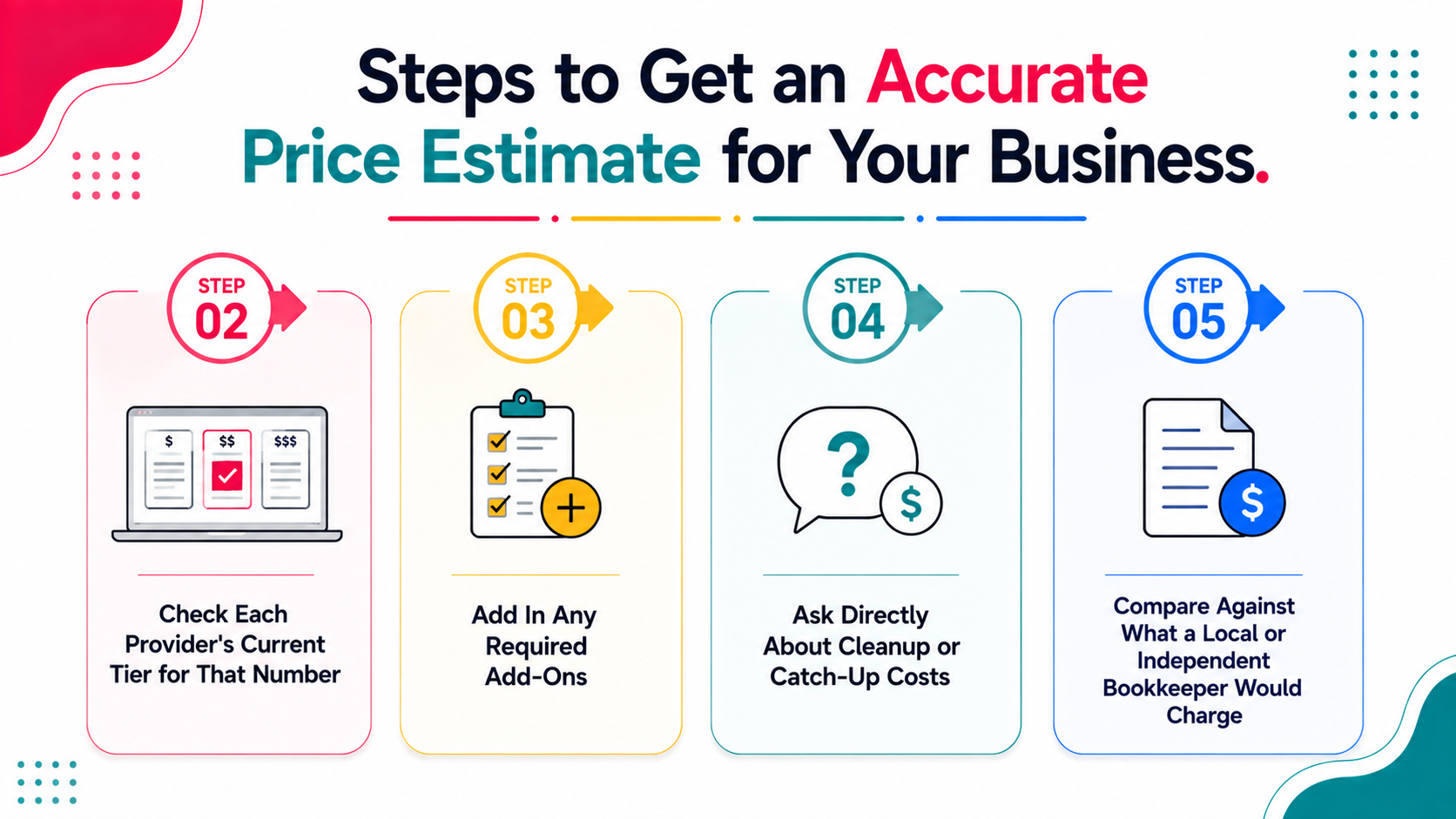
Rather than comparing advertised starting prices, work through these steps to get a realistic number for your specific business.
Step 1: Calculate Your Actual Average Monthly Expenses
Since all three providers price based on this figure, pull your actual average from the last three to six months of financials, not a rough guess.
Step 2: Check Each Provider's Current Tier for That Number
Visit each provider's pricing page directly and find the tier your actual expense number falls into, since published tier boundaries change periodically.
Step 3: Add In Any Required Add-Ons
Factor in tax filing, advisory services, or a required QuickBooks Online subscription, depending on which provider you are evaluating, since these are not always included in the headline price.
Step 4: Ask Directly About Cleanup or Catch-Up Costs
If your books are not already current and reconciled, ask specifically what catch-up work costs before signing up, since this is almost always billed separately from the ongoing rate.
Step 5: Compare Against What a Local or Independent Bookkeeper Would Charge
These three are not the only options. A local bookkeeper or a specialized firm may offer more tailored service at a comparable or lower price, depending on your specific needs.
Try Xenett Pulse Free. If you are comparing providers, get an objective read on your current books first. See your books health score in under two minutes, free for the first 100 firms.
Where the Real Trade-Offs Are
Price alone does not capture the most important differences between these options.
1. Software Lock-In
Bench and Pilot use their own proprietary platforms, which means your books live inside their system rather than in QuickBooks or Xero. Switching providers later can mean migrating your data out of a system not built for easy export. QuickBooks Live, by contrast, keeps your books in QuickBooks Online, which is more portable if you ever want to switch providers or bring bookkeeping in-house.
2. Depth of Advisory Support
If your business genuinely needs cash flow forecasting, KPI tracking, and strategic advisory conversations, Pilot's higher price may be justified. If you mainly need accurate, current books and a P&L you can trust, that level of advisory support may be more than you need to pay for.
3. Consistency of Your Bookkeeper
All three providers can assign or reassign bookkeepers as part of their operations. If continuity with a specific person matters to you, ask directly about how each provider handles this, since it varies and is not always advertised clearly upfront.
Hidden Costs That Do Not Show Up on the Pricing Page
Beyond the advertised tier pricing, a few costs tend to surface only after signing up, and they are worth asking about directly during the sales process.
1. Cleanup or Catch-Up Fees
If your books are not already current and reconciled when you sign up, expect a separate catch-up quote before ongoing service begins. This can range from a few hundred dollars for recently maintained books to several thousand for books that have gone unreconciled for a year or more.
2. Tax Filing as a Separate Line Item
None of these three providers include tax preparation and filing in their core bookkeeping price. Bench and Pilot both offer it as an add-on service with its own fee, and QuickBooks Live does not include tax filing at all, positioning it as a separate service entirely. Factor this into any annual cost comparison, not just the monthly rate.
3. Tier Changes as Your Business Grows
Since all three price based on monthly expenses, a growing business will move into a higher pricing tier over time, sometimes with little advance notice. Ask each provider directly how tier changes are communicated and billed.
4. Cost of Switching Later
If you later decide to switch providers or bring bookkeeping in-house, exporting data cleanly matters. QuickBooks Live keeps your books natively in QuickBooks Online, making a future switch simpler. Bench and Pilot both use proprietary systems, which can mean additional cost or complexity if you need to migrate that data elsewhere down the line.
When a Local Firm or Independent Bookkeeper Makes More Sense
These three national providers are not automatically the right choice for every business, and it is worth understanding when a more traditional option might serve you better.
Businesses With Highly Specific Industry Needs
A business in a niche industry, construction with complex job costing, a medical practice with specific compliance needs, a nonprofit with restricted fund accounting, often benefits more from a bookkeeper or firm with direct experience in that industry than from a generalist national provider, regardless of how polished that provider's platform is.
Businesses Wanting a Deeper Advisory Relationship
While Pilot includes advisory services, the relationship still operates within a structured, somewhat standardized service model. A local CPA or advisory firm can sometimes offer a more personalized, flexible relationship, particularly for complex tax planning or strategic decisions that benefit from an advisor who knows the business deeply over years, not just from quarterly check-ins.
Businesses Prioritizing In-Person Availability
All three national providers operate primarily through remote communication: email, chat, and scheduled calls. A business owner who strongly prefers in-person meetings or same-day phone availability may find a local firm a better fit, even at a comparable or higher price point.
Very Small Businesses With Minimal Complexity
For a very small business with extremely simple finances, sometimes the most cost-effective option is a part-time local bookkeeper working a few hours a month, rather than any of these three structured service tiers, which are generally built around a baseline level of service that may exceed what a truly minimal operation actually needs.
Frequently Asked Questions
How much does Bench cost compared to Pilot?
Pilot is generally more expensive than Bench at comparable revenue levels, reflecting Pilot's inclusion of more advisory-level services alongside bookkeeping. Bench is positioned closer to bookkeeping-only pricing.
Does QuickBooks Live require a separate QuickBooks Online subscription?
Yes. QuickBooks Live is an add-on service to QuickBooks Online, so its total cost includes the underlying QBO subscription in addition to the Live service fee.
Is cleanup or catch-up bookkeeping included in these services?
No, typically not. Bench, Pilot, and QuickBooks Live generally price catch-up or cleanup work as a separate, additional service, not included in the standard ongoing monthly rate.
Which is cheaper, Bench or QuickBooks Live?
It depends on whether you already pay for QuickBooks Online. If you do, the two can be fairly comparable at similar revenue levels. If you do not already use QuickBooks Online, that additional cost should be factored into any QuickBooks Live comparison.
Can I switch bookkeeping providers easily if I start with Bench or Pilot?
It can be more involved than switching from QuickBooks Live, since Bench and Pilot use proprietary platforms rather than keeping your books natively in QuickBooks or Xero. Migrating out of their systems takes more effort than switching between QuickBooks-native providers.
Conclusion
Bench, Pilot, and QuickBooks Live are not interchangeable options at different price points, they are built around different service models. Pilot leans advisory-heavy at a higher cost, Bench focuses on straightforward bookkeeping, and QuickBooks Live ties you into the QuickBooks ecosystem specifically.
Related guides
- Start here: What Is Outsourced Bookkeeping?
- Will AI Replace Accountants? — What the data says about AI and the accounting profession.
- Accounting Advisory Services — What advisory services are and how to start offering them.
The right comparison is not which one is cheapest on paper, it is which service model actually matches what your business needs month to month, and whether a national provider is even the right category of solution compared to a local firm or independent bookkeeper suited to your specific situation. Try Xenett Pulse to see the real condition of your books before comparing what any provider should reasonably charge you.