

Blog Summary
- AI will not replace accountants but it is already replacing specific tasks: data entry, transaction categorization, and pattern detection.
- The tasks AI cannot replace: judgment, client relationships, complex problem-solving, and advisory work.
- Accounting firms that use AI tools alongside their expertise will outcompete firms that ignore them.
- AI-powered diagnostics like Xenett Pulse already automate pre-engagement file reviews that previously took 2 to 4 hours.
- The accountants most at risk are those doing only data entry and basic categorization: tasks AI handles well.
- The accountants with the strongest future are those who use AI to handle the routine and focus on the advisory.
Every few months a headline appears about AI replacing accountants. The accounting profession collectively worries. Then goes back to work.
The worry is understandable. AI is genuinely changing the work. But changing and replacing are not the same thing. The more useful question is not whether AI will replace accountants. It is which parts of accounting AI is already handling, which parts it cannot handle, and what that means for how accounting firms should position themselves right now.
Part of our complete guide: outsourced bookkeeping guide
What the Data Actually Shows
The data shows AI is replacing specific accounting tasks: data entry, transaction categorization, and pattern detection. But it is not replacing the judgment, client relationships, and complex problem-solving that define accounting at its most valuable.
The Bureau of Labor Statistics projects accountant and auditor employment to grow over the next decade, even as automation increases. The reason: demand for accounting expertise is growing faster than automation can absorb it. Small businesses are being created at a record pace. Regulatory complexity is increasing. Advisory services, the highest-value part of accounting, require human judgment that AI cannot replicate.
What AI is replacing is not accountants. It is the low-value, repetitive parts of accounting work that accountants did not want to do anyway.
What AI Is Already Doing in Accounting
AI is already handling four categories of accounting work: data entry and categorization, pattern detection and anomaly flagging, report generation, and preliminary diagnostic analysis.
1. Data Entry and Transaction Categorization
Bank feeds in QuickBooks Online already use machine learning to suggest transaction categories based on payee history. This has reduced the time spent on manual categorization significantly. The categorization still needs review, but the first pass is automated.
2. Pattern Detection and Anomaly Flagging
AI can identify transactions that deviate from expected patterns faster and more consistently than a human reviewer working through a large transaction list. This is one of the key features of Xenett Pulse. The diagnostic uses GPT integration to define customizable conditions for review and flag discrepancies automatically. A human reviewer would need hours to identify the same anomalies across a large file. Pulse identifies them in 1 minute 42 seconds.
3. Report Generation
Standard financial reports (P&L, balance sheet, cash flow) are generated automatically in QuickBooks. No manual compilation required. The report is ready. What requires a human: interpreting what the report means, identifying what changed and why, and advising the client on what to do about it.
4. Preliminary Diagnostic Analysis
This is where AI is having the most direct impact on accounting firm operations. Pre-engagement file reviews that previously took two to four hours can now be automated. Xenett Pulse runs a 20-point diagnostic on a QuickBooks file in 1 minute 42 seconds. The output is a Books Health Score (0 to 100), ranked risk areas, and transaction-level findings across banking, AR, AP, reconciliations, and coding. A senior accountant would take two to four hours to produce the same analysis manually. AI produces it in under two minutes.
What AI Cannot Do in Accounting
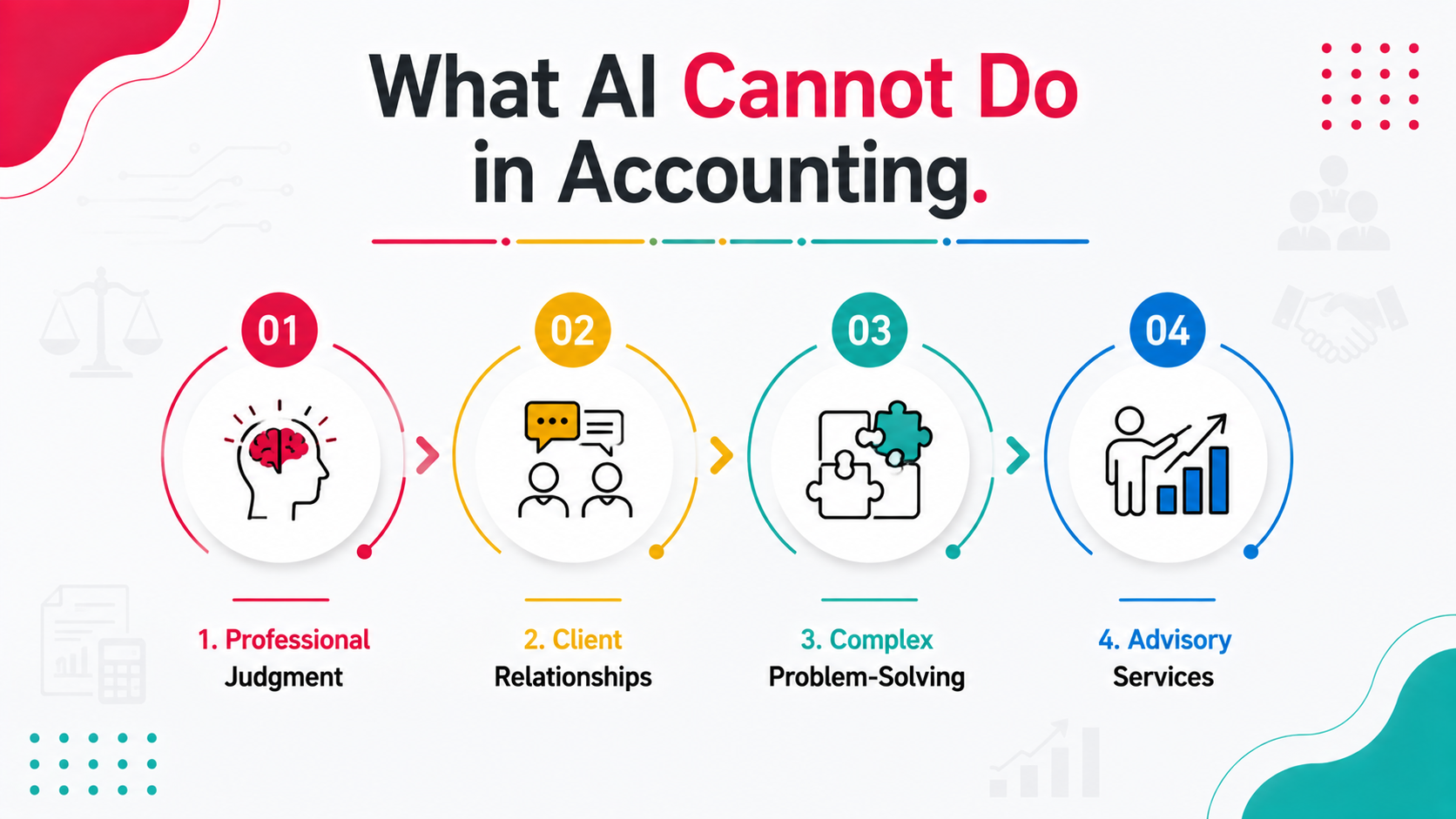
AI cannot replace the judgment, client relationships, ethical responsibility, and complex problem-solving that define accounting at its highest value.
1. Professional Judgment
Accounting involves judgment calls that require context, experience, and professional accountability. Which revenue recognition method fits this client's business model? Is this expense appropriately capitalized or should it be expensed? How should this unusual transaction be classified to accurately represent the economic reality? AI can flag that something looks unusual. It cannot make the professional judgment about what to do about it.
2. Client Relationships
An accounting firm's strongest asset is the trust clients place in it. That trust is built through conversations, through understanding the client's business, through being the person a business owner calls when they are worried about their finances. AI does not build trust. It processes data. The client relationship, the reason clients stay for years and refer their friends, is entirely human.
3. Complex Problem-Solving
A business owner is going through a divorce and needs to understand how the business valuation will be assessed. A client is being audited and needs help responding to an IRS notice. A firm is considering acquiring a competitor and needs financial due diligence. These situations require experience, judgment, and the ability to navigate complexity that has no clean algorithmic answer. AI is not equipped to handle any of them.
4. Advisory Services
Advisory is where accounting firms are heading, and where AI has the least reach. A client who wants to understand what their financials mean for their growth plans, their pricing strategy, or their hiring decisions needs a human who understands both accounting and business. AI can produce the data. The accountant provides the insight.
The Tasks Most at Risk vs Least at Risk
The accounting tasks most at risk from AI are the ones that are repetitive, rule-based, and data-intensive. The tasks least at risk require judgment, relationships, and complex reasoning.
| Task | AI Risk Level | Why |
|---|---|---|
| Manual data entry | High | Fully automatable |
| Transaction categorization | High | ML already handles the first pass |
| Bank feed reconciliation | Medium | AI assists, human reviews |
| Standard report generation | High | Automated in QBO |
| Pre-engagement file diagnostics | High | Tools like Pulse automate this |
| Audit preparation | Medium | AI assists, human leads |
| Tax strategy and planning | Low | Requires judgment and context |
| Client advisory | Very Low | Requires trust and relationships |
| Complex problem-solving | Very Low | Requires experience and reasoning |
| Business valuation | Very Low | Requires professional judgment |
The pattern is clear. Routine, repetitive, data-processing tasks are being automated. Judgment, relationship, and advisory tasks are growing in value.
What This Means for Accounting Firms
Accounting firms that use AI tools to handle the routine will free up time for the advisory work that AI cannot do. Firms that ignore AI will be outcompeted on efficiency by firms that use it. This is not a threat to accounting as a profession. It is a restructuring of what accountants spend their time on.
A firm that uses Xenett Pulse to run pre-engagement diagnostics in 2 minutes instead of 2 hours is not replacing their accountants. They are freeing those accountants from a manual, repetitive task so they can spend that time on client relationships and advisory work. A firm that uses automated transaction categorization is not eliminating their bookkeepers. They are enabling those bookkeepers to review more files, catch more errors, and spend more time on the work that requires human judgment.
The firms that will struggle are those doing primarily data entry and basic categorization without adding any judgment or advisory value. Those are the tasks being automated. The firms that will thrive are those that use AI to handle the routine and focus their human expertise on the advisory.
How AI Is Being Used in Accounting Today
The most practical AI applications in accounting today are automated transaction categorization, anomaly detection, diagnostic reporting, document processing, and workflow automation.
| AI Application | What It Does | Tool Example |
|---|---|---|
| Transaction categorization | Suggests categories based on payee and history | QuickBooks bank feed ML |
| Anomaly detection | Flags transactions deviating from expected patterns | Xenett Pulse GPT integration |
| Diagnostic reporting | Generates file health reports automatically | Xenett Pulse 20-point diagnostic |
| Document processing | Extracts data from invoices and receipts | Various OCR tools |
| Workflow automation | Automates recurring project setup and task assignment | Xenett Workflow Management |
Each of these tools reduces the time accountants spend on repetitive tasks. None of them replaces the accountant. They replace the parts of the accountant's work that did not require an accountant.
Stop Absorbing Catch-Up Overruns
Run a 20-point Xenett Pulse diagnostic in under 2 minutes and quote from evidence, not estimation.
Sign Up FreeA Common Situation We See
A five-person bookkeeping firm spends approximately 40 hours per month on pre-engagement file reviews across new prospects. Senior accountants review files manually. Each review takes two to four hours. Ten new prospects a month. After implementing Xenett Pulse for pre-engagement diagnostics, the same 10 reviews take 17 minutes total. The 40 hours per month previously spent on manual file reviews is now available for client advisory calls, proposal writing, and business development. The firm takes on more clients. Revenue increases. No accountants were replaced. Their time was redirected to higher-value work.
How Xenett Pulse Uses AI in Accounting
Xenett Pulse is a practical example of AI augmenting accounting work. The diagnostic uses GPT integration to define customizable conditions for review and flag discrepancies automatically. It identifies transactions that deviate from expected patterns and highlights only the most relevant issues for the reviewer. This is not AI replacing the accountant's judgment. It is AI handling the pattern-detection work so the accountant can focus on what to do about what was found.
The 20-point diagnostic runs in 1 minute 42 seconds. The output is a Books Health Score (0 to 100), ranked risk areas, and transaction-level findings. The accountant reviews the findings and applies their judgment to scope, price, and plan the engagement. AI does the detection. The accountant does the thinking.
Sign up free and see how AI-powered diagnostics fit into your pre-engagement process. Or download a sample report to see what the output looks like.
Frequently Asked Questions
Will AI replace accountants?
No, but AI is replacing specific accounting tasks, particularly data entry, transaction categorization, and pattern detection. Accountants who focus on judgment, client relationships, and advisory work are not at risk. Accountants doing primarily repetitive data-processing work face the most disruption.
What accounting tasks can AI do?
AI can handle: transaction categorization, anomaly detection, standard report generation, document data extraction, pre-engagement file diagnostics, and workflow automation.
What accounting tasks can AI not do?
AI cannot replace: professional judgment, client relationships, complex problem-solving, tax strategy, audit navigation, business advisory, and situations requiring ethical accountability.
How is AI being used in accounting firms today?
The most common applications are automated transaction categorization in accounting software, anomaly detection in review tools, and diagnostic reporting for pre-engagement file assessment. Tools like Xenett Pulse automate the pre-engagement file review process, reducing a 2 to 4 hour manual task to under 2 minutes.
Should accountants be worried about AI?
Accountants doing advisory, client relationship, and complex problem-solving work should not be worried. Accountants doing primarily repetitive data-entry and categorization work should consider how to add more judgment and advisory value to their role.
How can accounting firms use AI to their advantage?
Use AI tools to automate the routine: pre-engagement diagnostics, transaction categorization, report generation, and workflow setup. Redirect the time saved to client advisory, business development, and higher-value engagements.
What is the future of accounting with AI?
The future of accounting involves accountants spending less time on data processing and more time on advisory, strategy, and client relationships. Firms that adopt AI tools now will have a compounding efficiency advantage over firms that delay.
Related guides
- Start here: What Is Outsourced Bookkeeping?
- Accounting Advisory Services — What advisory services are and how to start offering them.
- Bench vs Pilot vs QuickBooks Live — How Bench, Pilot and QuickBooks Live compare on cost.
.avif)