



Blog Summary
- Most proposals underquote because scope is written before the file condition is known.
- Run a pre-engagement diagnostic before writing the proposal, not after.
- A complete proposal has six sections: executive summary, scope, fee, timeline, exclusions, and next steps.
- Write the scope as a specific task list from diagnostic findings, not a general service description.
- Price from the diagnostic: list every task, estimate hours, multiply by rate, add a complexity buffer.
- Always include an exclusions section with an explicit out-of-scope billing clause.
- Xenett Pulse runs a 20-point diagnostic in 1 minute 42 seconds and produces the evidence layer for the scope.
Most accounting proposals are written the same way.
A quick call with the prospect.
A rough sense of what the books look like.
A fee that feels about right.
A two-page document that says "monthly bookkeeping services" and lists a price.
The client signs.
Work starts.
Three weeks later the scope is twice what was proposed, because the books were in worse shape than anyone knew.
The proposal was not wrong because it was poorly written.
It was wrong because it was written without evidence.
This guide covers how to write an accounting services proposal that is backed by documented file data, protects your scope, and gives the client a clear picture of exactly what they are buying.
A free template is included at the end.
Part of our complete guide: guide to pricing bookkeeping services
What Is an Accounting Services Proposal?
An accounting services proposal is a document that outlines the scope of services, fee, timeline, and terms for a new client engagement, sent before the engagement letter and used to confirm agreement before formal onboarding begins.
It is not the same as an engagement letter.
The proposal is the sales document: it explains what you will do and what it will cost.
The engagement letter is the legal document: it formalizes the agreement and protects both parties.
Most firms send a proposal first.
If the client agrees, the engagement letter follows.
Here is how the two documents relate:
A strong proposal makes the engagement letter easier to write, because the scope is already documented and agreed.
A vague proposal makes the engagement letter harder, because the scope has to be rebuilt from scratch.
Why Most Accounting Proposals Underquote
Most accounting proposals underquote because the scope is written before the file condition is known, which means the fee is based on what the client describes, not what the books actually contain.
This is the same problem that drives scope overruns on cleanup engagements.
The client says the books are "pretty clean."
The proposal says "monthly bookkeeping — $X/month."
The engagement starts.
The books are not clean.
According to data from Xenett Pulse, 68% of engagements start with unvalidated books.
The average scope expansion after discovery is 3x.
That gap, between the proposed fee and the actual work, comes directly from writing the proposal without first knowing what is in the file.
The fix is running a diagnostic before the proposal is written.
Not after.
What to Include in an Accounting Services Proposal
A complete accounting services proposal has six sections: executive summary, scope of services, fee and billing terms, timeline, terms and exclusions, and next steps.
Each section has a specific job.
Here is what each one should cover:
The scope section is the most important.
Everything downstream, the fee, the timeline, the engagement letter, flows from how well the scope is written.
How to Write the Scope Section From Evidence
Write the scope section after running a pre-engagement diagnostic, not before. The diagnostic findings become the evidence layer behind every line in the scope.
Here is the difference between a scope written without evidence and one written from a diagnostic:
Without evidence:
"We will provide monthly bookkeeping services including bank reconciliations, transaction categorization, and monthly financial statements."
With diagnostic evidence:
"We will reconcile three bank accounts and two credit card accounts monthly. We will categorize all transactions in QuickBooks Online and correct the 47 miscoded transactions identified in the pre-engagement review. We will prepare a monthly P&L and balance sheet, delivered by the 10th of the following month. Initial cleanup covers the period January 2024 through present, addressing the reconciliation gaps in accounts X and Y identified in the diagnostic."
The second version tells the client exactly what is happening.
It is based on what Pulse surfaced: specific accounts, specific issues, specific deliverables.
There is no ambiguity.
There is no room for "I thought that was included."
Xenett Pulse runs a 20-point diagnostic on the QuickBooks file in 1 minute 42 seconds and surfaces every issue across banking, AR, AP, reconciliations, and transaction coding, ranked by severity.
The Books Health Score (0 to 100) tells you the overall file condition at a glance.
The transaction-level findings tell you exactly what needs to be fixed.
Both feed directly into the scope section of the proposal.
How to Price the Engagement in the Proposal
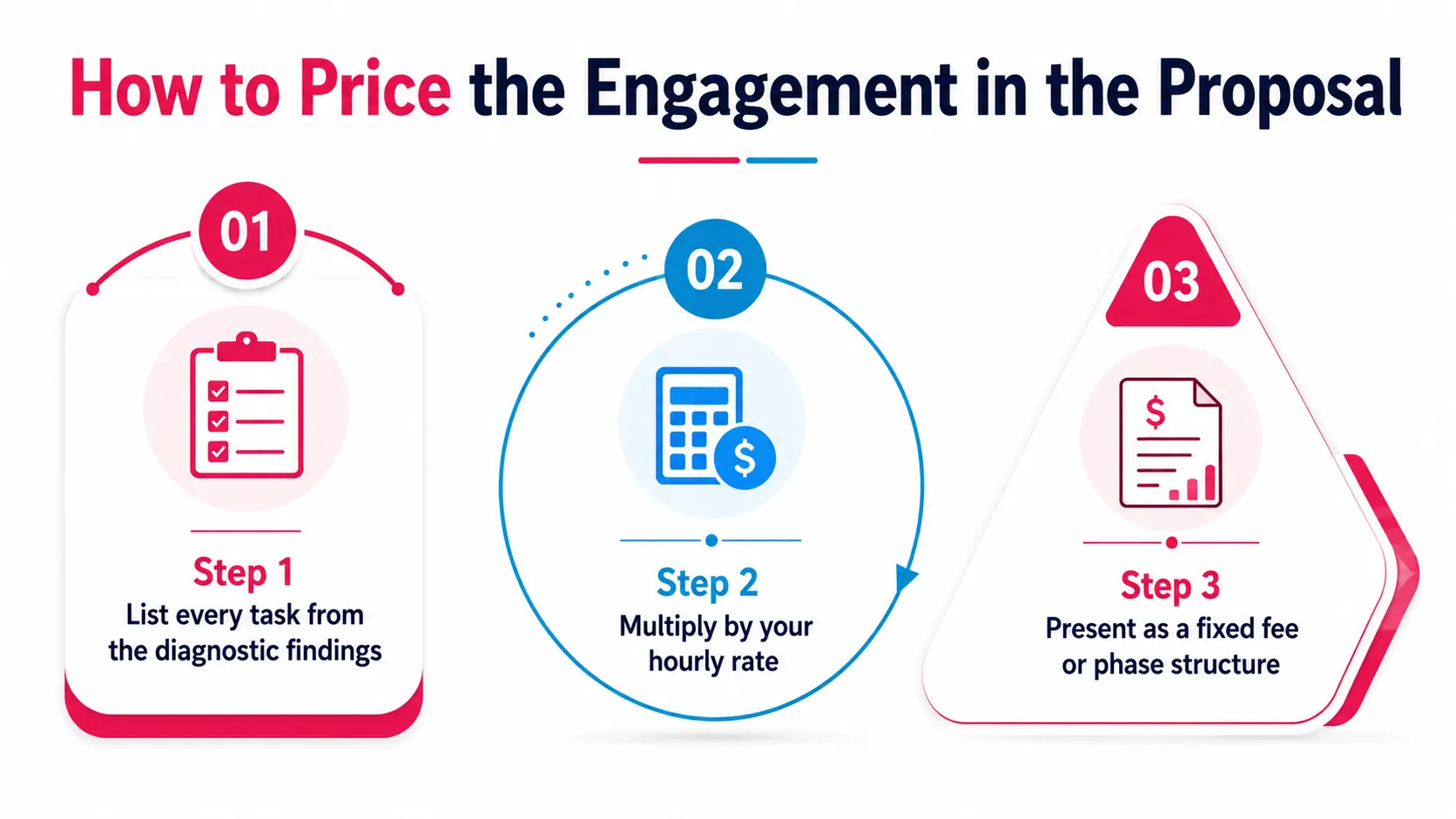
Price the engagement based on the diagnostic findings, not the client's description of their books. Map each finding to an estimated time, then build the fee from the hours up.
Here is a simple pricing framework:
Step 1: List every task from the diagnostic findings
Use the Pulse output to build a task list:
- Reconcile accounts X, Y, Z from [date] through [date]: estimated X hours
- Remove duplicate transactions: estimated X hours
- Fix miscoded expenses in [categories]: estimated X hours
- Ongoing monthly bookkeeping: estimated X hours per month
Step 2: Multiply by your hourly rate
Total hours multiplied by your rate equals your floor.
Add a buffer for complexity: 15 to 20% for moderate files, 25 to 30% for high-complexity files.
Step 3: Present as a fixed fee or phase structure
For cleanup engagements, phase the work:
- Phase 1: Historical cleanup, $X (one-time)
- Phase 2: Ongoing monthly bookkeeping, $X per month
Phased pricing makes large cleanup fees easier for clients to accept, and easier for you to invoice in milestones.
The Exclusions Section — Do Not Skip It
The exclusions section is what prevents scope creep. List every service that is not included, explicitly, so there is no room for a client to assume it is covered.
Common exclusions for a bookkeeping proposal:
- Tax preparation and filing
- Payroll processing
- CFO or financial advisory services
- Historical cleanup prior to the engagement start date (if not in scope)
- Accounts payable management (if not in scope)
- Inventory management
- Job costing
Also include your out-of-scope billing rate:
"Work outside the scope defined above will be billed at $[X] per hour. Out-of-scope work requires written approval before it begins."
This clause does two things.
It sets the rate before any dispute arises.
It creates a documented approval process for scope expansion.
Stop Absorbing Catch-Up Overruns
Run a 20-point Xenett Pulse diagnostic in under 2 minutes and quote from evidence, not estimation.
Sign Up Free
A Common Situation We See
An accounting firm sends a proposal for monthly bookkeeping at $900/month.
The proposal was written after a 20-minute prospect call.
No diagnostic was run.
The client signs.
Work starts.
The firm discovers the client has five bank accounts, not two, and three of them have not been reconciled in over a year.
The $900/month fee does not come close to covering the actual work.
After adding Xenett Pulse to their pre-proposal process, the same firm now runs a diagnostic before every proposal call.
The Books Health Score and ranked risk areas from the diagnostic become the basis for the scope section.
The fee reflects the actual work.
Scope overruns on new engagements dropped to near zero.
Free Accounting Services Proposal Template
Use this template as a starting point. Customize the bracketed fields for each client.
ACCOUNTING SERVICES PROPOSAL
Prepared by: [Your Firm Name]
Prepared for: [Client Business Name]
Date: [Date]
Valid until: [Date, typically 30 days]
1. Overview
[Your Firm Name] is pleased to submit this proposal to provide accounting and bookkeeping services to [Client Business Name].
Based on our pre-engagement review of your QuickBooks file, we have identified the following areas requiring attention: [list 2 to 3 key findings from Pulse diagnostic].
This proposal outlines the scope of services, fees, and timeline to bring your books current and maintain accurate records on an ongoing basis.
2. Scope of Services
Phase 1: Historical Cleanup (One-Time)
- Reconcile [list accounts] from [start date] through [end date]
- Remove [X] duplicate transactions identified in pre-engagement review
- Correct miscoded transactions in [categories]
- Apply unapplied payments in accounts receivable
- Resolve reconciliation gaps in [accounts]
- Estimated completion: [X] weeks from engagement start
Phase 2: Ongoing Monthly Bookkeeping
- Reconcile [list accounts] monthly
- Categorize all transactions in QuickBooks Online
- Prepare monthly profit and loss statement and balance sheet
- Deliver financial package by the [X]th of the following month
- [Add or remove services as applicable]
3. Fee and Billing
Phase 1: Historical Cleanup: $[Amount] (one-time, invoiced in [X] milestones)
Phase 2: Ongoing Monthly Bookkeeping: $[Amount] per month, billed on the [1st or 15th]
Payment due within [15 or 30] days of invoice.
Out-of-scope work: $[Hourly Rate] per hour, requires written approval before work begins.
4. Timeline
Engagement start date: [Date]
Phase 1 completion: [Date]
First monthly deliverable: [Date]
5. Exclusions
The following services are not included in this proposal unless agreed separately:
- Tax preparation or filing
- Payroll processing
- CFO or financial advisory services
- [Any other relevant exclusions]
6. Next Steps
To proceed, please reply to confirm your acceptance of this proposal.
We will then issue a formal engagement letter for signature before work begins.
If you have questions about any part of this proposal, please contact [Name] at [Email/Phone].
This proposal is valid for 30 days from the date above.
How Xenett Can Help
The most important input to any accounting proposal is a clear picture of the file condition before you write it.
Xenett Pulse connects to a prospect's QuickBooks file and runs a complete 20-point diagnostic in 1 minute 42 seconds.
The output is a Books Health Score from 0 to 100, ranked risk areas across banking, AR, AP, reconciliations, and coding, and transaction-level findings that show exactly what is wrong and how severe each issue is.
That output becomes the evidence layer behind the scope section of your proposal.
You walk into the proposal conversation knowing exactly what is in the file.
The fee reflects the actual work.
The scope holds.
68% of engagements start with unvalidated books.
Running Pulse before the proposal puts your firm in the other 32%.
A proposal wins the client. A specific, evidence-based proposal wins the client and protects the margin.
Sign up free and run your first diagnostic before your next proposal goes out.
Or download a sample report to see exactly what the diagnostic output looks like.
Frequently Asked Questions
What is an accounting services proposal?
An accounting services proposal is a document that outlines the scope of services, fee, timeline, and terms for a new client engagement. It is sent before the engagement letter: it is the sales document that confirms what will be done and at what cost before the formal agreement is signed.
What should be included in an accounting proposal?
A complete proposal includes six sections: executive summary, scope of services, fee and billing terms, timeline, terms and exclusions, and next steps. The scope section is the most important: write it as a specific task list based on documented file findings, not a general service description.
How do I price an accounting services proposal?
Price based on the diagnostic findings from a pre-engagement file review. List every task identified in the diagnostic, estimate hours per task, multiply by your rate, and add a complexity buffer. Present as a fixed fee with phased billing for large cleanup engagements.
What is the difference between a proposal and an engagement letter?
A proposal is the sales document: it outlines scope, fee, and timeline for the client to review and accept. An engagement letter is the formal agreement: it includes legal terms, client responsibilities, and signatures from both parties. The proposal comes first. The engagement letter follows once the proposal is accepted.
How do I prevent scope creep in an accounting proposal?
Write the scope as a specific task list, not a general category. Include an explicit exclusions section listing every service not covered. Add an out-of-scope billing clause with your hourly rate and a written approval requirement. Run a pre-engagement diagnostic before writing the scope so the fee is based on actual file condition, not the client's description.
Should I run a QuickBooks diagnostic before sending a proposal?
Yes, always. A pre-engagement diagnostic surfaces every issue in the file before scope and pricing are locked. Xenett Pulse runs a 20-point diagnostic in 1 minute 42 seconds and produces a ranked risk report with a Books Health Score, giving you the evidence to write an accurate proposal and price the work correctly.
How long should an accounting proposal be?
Long enough to cover the six sections clearly, typically one to three pages. The scope section will be longer for complex engagements with cleanup work. The most important thing is specificity: a two-page proposal with a detailed task-level scope is more effective than a five-page proposal with a vague service description.
Accounting Proposal: At a Glance
Related guides
- Start here: How to Price Bookkeeping Services
- Why Bookkeeping Scope Creep Happens — Why scope creep happens on cleanup work, and how to price around it.
- Bookkeeping Mistakes That Blow Up Fixed Fees — The bookkeeping mistakes that blow up a fixed fee.
- Bookkeeping Pricing Calculator — Run your numbers with the bookkeeping pricing calculator.
Run a free Xenett Pulse diagnostic before your next proposal and write the scope from evidence, not estimation.


.avif)