



Blog Summary
- Professional bookkeeping cleanup includes reconciliation catch-up, transaction recoding, duplicate removal, and correcting the chart of accounts, not just a quick review.
- Cleanup pricing should be based on the actual condition of the books, verified through a diagnostic, not a flat rate regardless of complexity.
- A cleanup that skips reconciliation entirely is not a real cleanup, even if it makes the reports look cleaner on the surface.
- Cleanup should always be priced and delivered as a distinct project, separate from any ongoing monthly bookkeeping that follows it.
- The best providers show you exactly what was found and fixed, not just a final your books are clean now without evidence.
Introduction
Bookkeeping cleanup services get sold under wildly different definitions, which makes it hard to know what you are actually buying until the invoice arrives.
Some providers treat cleanup as a quick pass to make the books look presentable for tax season. Others treat it as a full forensic rebuild, reconstructing a year or more of transaction history from scratch. Both get called bookkeeping cleanup, and the price difference between them is enormous, which is exactly why so many business owners feel blindsided by a cleanup quote.
This guide breaks down what a genuine, professional cleanup actually includes, what it should reasonably cost based on the real condition of the books, and how to tell a thorough provider from one doing a surface-level pass.
Part of our complete guide: complete QuickBooks cleanup guide
What Bookkeeping Cleanup Actually Means
At its core, bookkeeping cleanup is the process of correcting a set of books that have fallen out of accuracy, so they reflect what actually happened financially.
1. It's Different From Ongoing Bookkeeping
Ongoing bookkeeping maintains books that are already accurate. Cleanup is a distinct, bounded project meant to fix books that have accumulated errors, gaps, or inconsistencies over time.
2. The Scope Depends Entirely on How the Books Got There
A file that has been mostly maintained but has three unreconciled months needs a very different scope of work than a file that has not been touched by a professional in two years.
3. It Should Have a Defined Endpoint
A proper cleanup engagement has a clear scope and a clear finish line: books reconciled and accurate through a specific date. It should not be an ongoing, undefined activity billed indefinitely.
If a provider cannot tell you what done looks like for your cleanup, that is worth asking about directly before starting the engagement.
What's Included in a Professional Cleanup
A genuine cleanup engagement covers several specific categories of work, not just a general tidy-up.
| Component | What It Involves | Why It's Necessary |
|---|---|---|
| Reconciliation catch-up | Reconciling every bank, credit card, and loan account through the current date | Confirms the books match actual account activity |
| Transaction recoding | Correcting miscategorized or inconsistently coded transactions | Ensures reports reflect accurate categories |
| Duplicate removal | Identifying and removing transactions entered more than once | Prevents inflated expenses or revenue |
| Chart of accounts cleanup | Consolidating redundant accounts, fixing structure issues | Makes ongoing reporting clearer and more useful |
| AR and AP review | Clearing out stale, uncollectible, or incorrectly aged items | Produces an accurate balance sheet |
| Opening balance verification | Confirming beginning balances tie out to actual statements | Establishes a trustworthy starting point |
1. Reconciliation Catch-Up
Every account gets reconciled against actual bank and credit card statements through the current date. A cleanup that does not do this has not actually verified the books, regardless of anything else it includes.
2. Transaction Recoding
Transactions sitting in generic categories like uncategorized expense, or coded inconsistently across similar vendors, get reviewed and corrected to reflect what they actually were.
3. Duplicate Removal
Duplicate entries, often introduced by double bank feed imports, get identified and removed so account balances reflect real activity.
4. Chart of Accounts Cleanup
A chart of accounts that has grown messy over time, with redundant or overly granular accounts, gets consolidated into a structure that actually supports useful reporting going forward.
5. AR and AP Review
Accounts receivable and payable often accumulate stale items that were never properly closed out. A real cleanup reviews these and clears out what no longer reflects reality.
6. Opening Balance Verification
If the beginning balances do not tie out to actual historical statements, everything built on top of them is unreliable, regardless of how clean the more recent months look.
Steps a Thorough Cleanup Should Follow
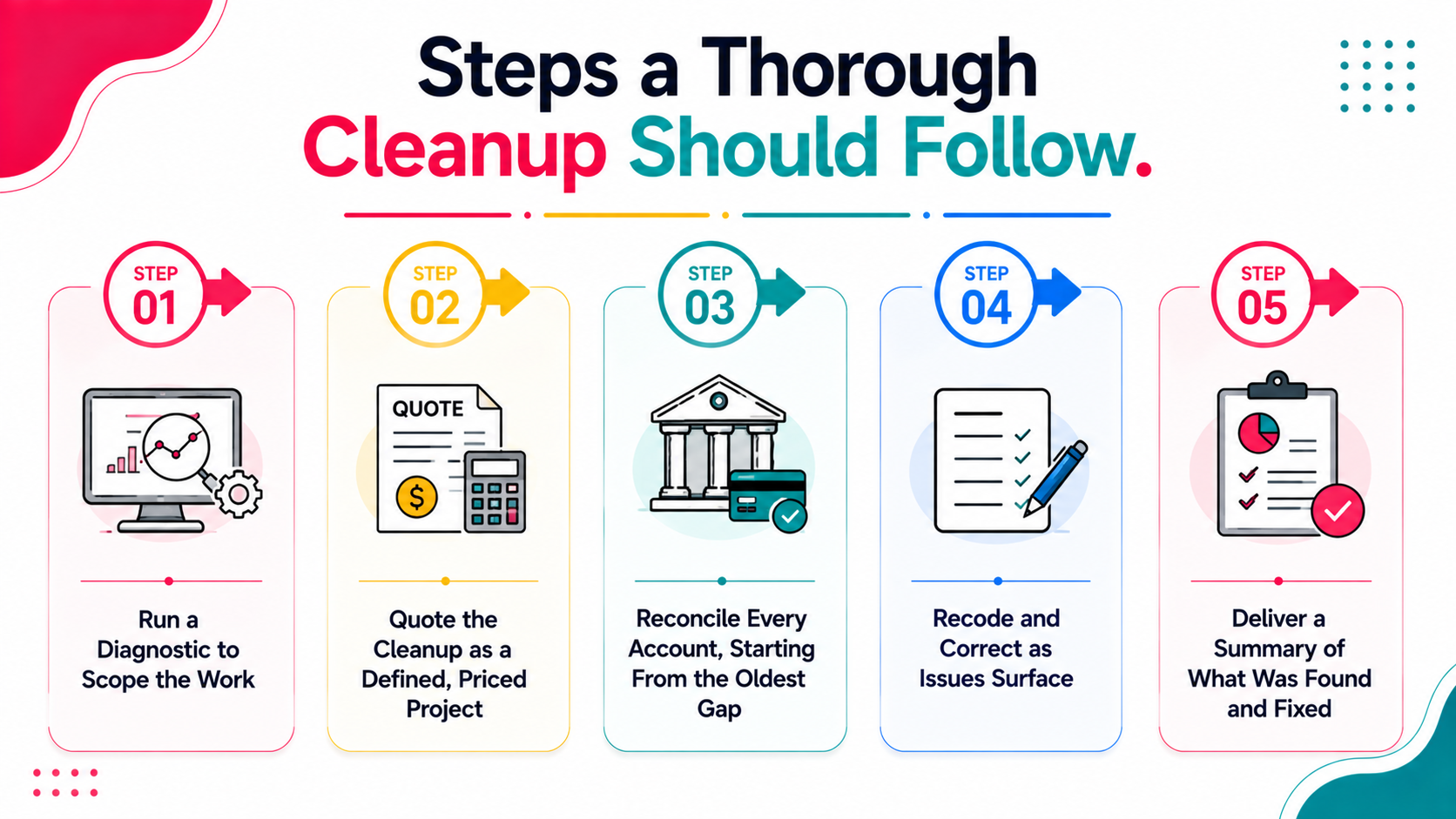
A well-run cleanup engagement follows a defined process, not an open-ended dig through the file.
Step 1: Run a Diagnostic to Scope the Work
Before any cleanup work begins, a proper diagnostic identifies exactly which accounts are unreconciled, how far back the issues go, and roughly how much work is involved. With Xenett Pulse, this takes under two minutes and produces a 0 to 100 books health score.
Step 2: Quote the Cleanup as a Defined, Priced Project
Based on the diagnostic findings, the provider should quote a specific scope and price, not an open-ended hourly arrangement with no ceiling.
Step 3: Reconcile Every Account, Starting From the Oldest Gap
Work through unreconciled accounts systematically, starting from the earliest gap, since later periods often depend on earlier balances being correct.
Step 4: Recode and Correct as Issues Surface
Fix miscategorized transactions and duplicates as they are found during the reconciliation process, rather than leaving them for a separate pass.
Step 5: Deliver a Summary of What Was Found and Fixed
A thorough provider documents what was wrong and what was corrected, not just a final everything is clean statement with no supporting detail.
Try Xenett Pulse Free. Scope every cleanup engagement with real findings instead of a guess. Free for the first 100 firms, no credit card required.
What Bookkeeping Cleanup Should Cost
Cleanup pricing varies significantly based on the real condition of the books and how far back the issues extend.
| Books Condition | Typical Scope | Rough Price Range |
|---|---|---|
| Mostly maintained, one to three months unreconciled | Light catch-up, minor recoding | Several hundred dollars |
| Moderate gaps, three to six months of issues across a few accounts | Multi-account reconciliation catch-up, moderate recoding | Low thousands |
| Significant gaps, six months to a year across most accounts | Extensive reconciliation, chart of accounts overhaul, AR and AP review | Mid to high thousands |
| Severe, over a year unreconciled or never professionally maintained | Full historical rebuild, possibly requiring prior-year adjustments | High thousands and up, often quoted as a multi-phase project |
These ranges are directional, not a guarantee, since the exact number depends on transaction volume, number of accounts, and industry complexity in addition to how long the books have gone unmaintained. A provider quoting a cleanup without first checking the actual file is quoting based on hope, not evidence.
Signs of a Rushed or Incomplete Cleanup
Not every cleanup delivers what it should. A few warning signs are worth watching for.
1. No Reconciliation Report Provided
If the provider cannot show you a completed reconciliation report for each account through the cleanup's end date, reconciliation likely did not actually happen, regardless of what the invoice says.
2. The Chart of Accounts Looks Untouched
If the chart of accounts still has obvious redundancies or a messy structure after the cleanup, the deeper structural work was likely skipped in favor of just fixing individual transactions.
3. No Documentation of What Was Found
A provider who cannot explain what was wrong and what they fixed has not given you anything you can verify. This documentation also matters if a question comes up later about a specific number.
A cleanup that comes back suspiciously fast, especially for books that were known to be in bad shape, is worth asking pointed questions about. Real reconciliation catch-up takes real time, and there is no way around that for a file with genuine gaps.
Questions to Ask Before Hiring a Cleanup Provider
Beyond spotting warning signs after the fact, a short set of questions asked upfront filters out providers likely to deliver a rushed or incomplete job before you ever sign an agreement.
Do You Run a Diagnostic Before Quoting
A provider who quotes a cleanup fee without first looking at the actual file is guessing. Ask specifically whether they check reconciliation status and transaction history before providing a number, or whether the quote is based on a general conversation alone.
Will Every Account Be Reconciled Through the End Date
Confirm explicitly that reconciliation will cover every bank, credit card, and loan account, not just the primary operating account. Secondary accounts are the most commonly skipped in a rushed cleanup, precisely because they are easy to overlook.
What Documentation Will I Receive When It's Done
Ask what you will actually receive at the end: a written summary of findings, completed reconciliation reports, or simply a verbal confirmation that everything is fine. Providers planning to do thorough work usually have no hesitation describing exactly what documentation comes with it.
How Do You Handle Findings That Require My Input
Some cleanup findings, an unclear transaction, a payment that might be personal rather than business, need the business owner's input to resolve correctly. Ask how the provider handles this: do they reach out with specific questions, or do they make assumptions and move on. The better answer involves genuine back-and-forth, not silent guessing.
What Happens If They Find More Than Expected
Ask directly what happens if the file turns out to need more work than the initial diagnostic suggested. A provider with a clear, fair process for handling scope changes, rather than either eating the extra cost silently or springing a large change order on you, is a better sign than one who has not thought through this scenario.
Frequently Asked Questions
What is included in bookkeeping cleanup services?
A professional cleanup typically includes reconciliation catch-up across all accounts, transaction recoding, duplicate removal, chart of accounts cleanup, accounts receivable and payable review, and opening balance verification.
How much does bookkeeping cleanup cost?
Cost depends heavily on the condition of the books. Light cleanup for mostly maintained books might cost several hundred dollars, while a severe, multi-year cleanup can run into the high thousands, often delivered as a multi-phase project.
How long does a bookkeeping cleanup take?
Timeline depends on scope, but even a moderate cleanup covering a few months across several accounts typically takes one to three weeks. Severe, multi-year cleanups can take significantly longer.
How do I know if I actually need a cleanup?
If you are unsure when your accounts were last reconciled, if a previous bookkeeper left abruptly, or if your financial reports do not seem to match reality, a diagnostic can confirm whether cleanup is needed and how extensive it should be.
What questions should I ask a provider before hiring them for cleanup?
Ask whether they run a diagnostic before quoting, whether every account will be reconciled through the end date, what documentation you will receive when finished, and how they handle findings that need your input or scope that turns out larger than initially expected. A provider willing to answer all four clearly is a strong signal of a thorough process.
Conclusion
Bookkeeping cleanup should mean the same thing regardless of who is providing it: every account reconciled, every transaction correctly coded, and a chart of accounts that actually supports useful reporting. Anything less is a partial fix wearing the same label.
Related guides
- Start here: QuickBooks Cleanup: The Complete Guide
- QuickBooks Cleanup Service Cost — What cleanup work costs, and what drives the price up.
- Catch-Up Bookkeeping and How to Price It — How catch-up bookkeeping differs from cleanup, and how to price it.
- Adjusted Trial Balance Explained — How to prepare the adjusted trial balance that closes out a cleanup.
Before hiring for a cleanup, or before quoting one, get a real diagnostic of the file first. Try Xenett Pulse to see exactly what a cleanup engagement should scope to, before the quote goes out.