



Blog Summary
- Bookkeeping pricing should be driven by transaction volume, account complexity, payroll, reporting needs, and the actual condition of the books, not a flat per-client rate.
- A quote built without checking the real state of the books is a guess, even if it feels informed.
- Monthly retainer pricing works better than hourly billing for ongoing bookkeeping, since it gives both sides a predictable number.
- The condition of the books at the start of an engagement should change the price, not just the timeline.
- Firms that price consistently, using the same framework every time, spend less time renegotiating scope mid-engagement.
Introduction
Ask ten bookkeepers how they price a new client and you will get ten different answers, and most of them will admit the number came from a gut feeling, not a formula.
That is not a knock on anyone's judgment. Pricing bookkeeping is genuinely harder than pricing most services, since the real cost depends on things that are not visible until you are already inside the file: how many accounts need reconciling, how messy the coding is, whether payroll is involved, what the client actually expects to see every month.
The calculator below gives you a starting range based on the factors that actually drive bookkeeping cost. Below it, the full framework explains why each factor matters, so you are not just trusting a number, you understand where it came from.
Part of our complete guide: guide to pricing bookkeeping services
Bookkeeping Pricing Calculator
Answer the five questions below to get a suggested monthly fee range.
What should you charge this client?
Answer five questions to get a monthly fee range based on real firm pricing patterns, not a guess.
The Five Factors That Actually Drive Bookkeeping Pricing
The calculator above is built on five inputs. Understanding why each one matters helps you adjust the number with judgment, not just accept it as-is.
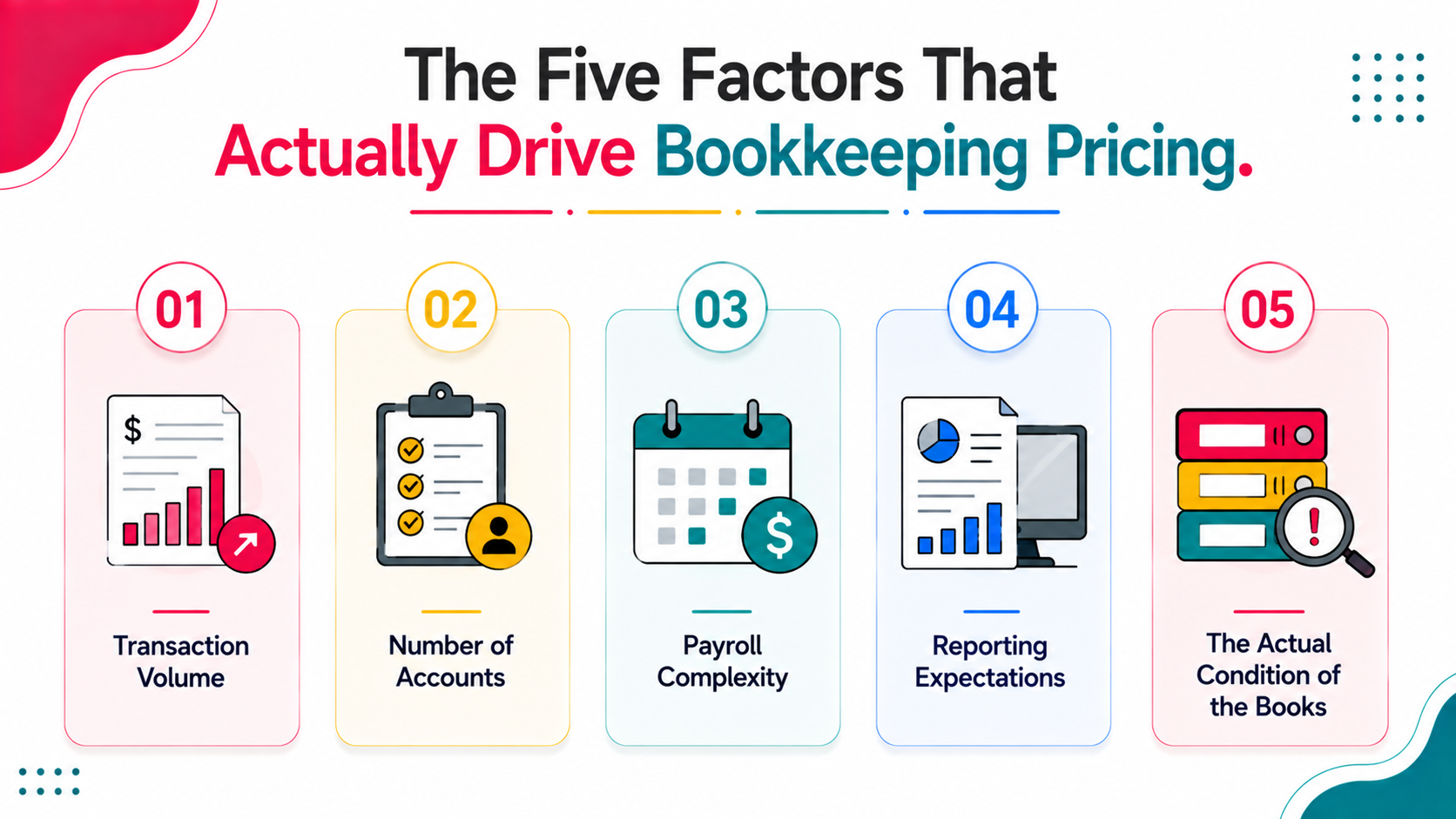
1. Transaction Volume
More transactions means more categorization, more matching, and more time spent every month. This is usually the starting point for any pricing model, since it scales roughly linearly with effort.
2. Number of Accounts
A client with 200 transactions across two accounts is simpler than a client with 200 transactions spread across eight accounts. Each additional account adds its own reconciliation, its own potential for errors, and its own monthly checklist item.
3. Payroll Complexity
Payroll errors are expensive and visible to employees immediately, which makes payroll-adjacent bookkeeping worth pricing at a premium relative to its transaction count alone.
4. Reporting Expectations
A client who wants a P&L and nothing else costs less to serve than one expecting monthly commentary, KPI tracking, or forecasting. This is often where firms most underprice, since the extra reporting work does not show up in transaction counts at all.
5. The Actual Condition of the Books
This is the factor a quick glance at the dashboard will not reveal. Reconciliation gaps and coding inconsistencies are invisible until someone actually checks, which is why the calculator asks for a health score rather than assuming clean books by default.
Steps to Price a New Bookkeeping Client
Beyond plugging numbers into a calculator, here is the process worth following for every new client.
Step 1: Run a Diagnostic Before Estimating Anything
Get read-only access to the client's QuickBooks file and check reconciliation status, coding accuracy, and account count directly, rather than relying on what the prospect tells you. With Xenett Pulse, this takes under two minutes.
Step 2: Plug the Real Numbers Into the Calculator
Use the actual transaction volume, account count, and health score from the diagnostic, not estimates from the discovery call alone.
Step 3: Adjust for Anything the Calculator Cannot See
Local market rates, your own experience level, and any unusual complexity specific to the client's industry all deserve a manual adjustment on top of the calculated range.
Step 4: Separate Cleanup From Ongoing Service in the Quote
If the diagnostic reveals real cleanup work, price that as its own line item, distinct from the ongoing monthly fee the calculator estimates.
Step 5: Put the Number in Writing With the Findings Attached
Send a quote that references the specific findings behind the price, not just a flat number. For guidance on this step, see our guide on turning diagnostic findings into a signed engagement.
Try Xenett Pulse Free. Get the real numbers behind every quote in under two minutes. Free for the first 100 firms, no credit card required.
Monthly Retainer vs. Hourly Pricing
Most firms eventually move away from hourly billing for ongoing bookkeeping, for reasons that go beyond simplicity.
| Hourly Billing | Monthly Retainer | |
|---|---|---|
| Predictability for the client | Low, invoice varies month to month | High, same fee every month |
| Predictability for the firm | Low, revenue tied to hours logged | High, revenue is stable and forecastable |
| Incentive alignment | Rewards slower work | Rewards efficient, well-run processes |
| Client trust | Can create friction over billed hours | Removes billing disputes entirely |
| Best fit | One-off or highly unpredictable projects | Ongoing monthly bookkeeping and CAS engagements |
The calculator above outputs a monthly retainer range specifically, since that is the pricing model that best fits recurring bookkeeping work.
Why the Health of the Books Changes the Number
Two clients with identical transaction volume can require very different amounts of monthly effort, entirely because of how clean their books were at the start of the engagement.
| Books Health Score | What It Usually Means | Impact on Monthly Price |
|---|---|---|
| 80 to 100 | Reconciled, consistently coded, minimal review needed | Standard rate, no adjustment |
| 50 to 79 | A few gaps, occasional miscoding | Modest increase to cover extra review time |
| 20 to 49 | Multiple unreconciled accounts, inconsistent coding | Meaningful increase, or cleanup priced separately first |
| Under 20 | Severe, likely needs a dedicated cleanup project before ongoing pricing makes sense | Cleanup quoted as its own project before setting an ongoing rate |
A client scoring under 50 is not necessarily a bad client to take on. It just means the ongoing rate needs to reflect the real condition of the file, or the cleanup needs to happen as a separate, upfront engagement before the monthly rate kicks in. Our guide on what unreconciled accounts really cost breaks down why this factor matters as much as it does.
Adjusting the Calculator's Range for Your Specific Market
The calculator gives a general starting range, but a few factors specific to your firm and location deserve a manual adjustment before finalizing any quote.
Local Market Rates Vary Significantly
Bookkeeping rates in a major metropolitan area with a high cost of living tend to run higher than rates in smaller markets, sometimes by a meaningful margin. If the calculated range feels consistently low or high compared to what similar firms in your area charge, trust that local knowledge over a generic number.
Your Experience and Positioning Matter
A firm with deep experience in a specific industry, or one positioned as a premium, high-touch service, can often charge above the calculated range and have clients accept it readily. The calculator estimates effort-based cost. It does not account for the premium a strong reputation or specialized expertise can command.
Industry-Specific Complexity Adds Its Own Layer
Certain industries carry complexity the standard inputs do not fully capture: inventory-heavy businesses, multi-location operations, or businesses with complex revenue recognition needs often require more judgment and review time than their raw transaction count alone would suggest. Add a manual premium for industries you know to be more complex than average, even if the calculator's inputs look otherwise standard.
Consider What Competing Firms in Your Market Charge
Beyond your own costs and effort, it helps to have a general sense of what other firms serving similar clients in your market charge for comparable service. This does not mean matching competitors exactly, but being aware of the going rate helps you position confidently, whether that means charging a premium for superior service or staying competitive on price for a specific client segment.
Frequently Asked Questions
How much should I charge for bookkeeping services?
Pricing depends on transaction volume, number of accounts, payroll complexity, reporting needs, and the condition of the books. Most small business monthly bookkeeping retainers fall between $250 and $1,500 per month, with higher-complexity or advisory-heavy engagements running higher.
Is monthly retainer pricing better than hourly billing for bookkeeping?
For ongoing bookkeeping, most firms find retainer pricing works better, since it gives both the firm and the client a predictable number and removes disputes over billed hours.
How do I price a client with messy books?
Run a diagnostic first to understand the real scope of the issues, then either build the extra review time into a higher ongoing rate or price the cleanup as a separate, upfront project before setting the ongoing monthly fee.
Does this calculator account for cleanup work?
The calculator estimates an ongoing monthly rate. If a client's books need real cleanup work first, that should be quoted as a separate project, not folded into the monthly number.
How accurate is a pricing calculator compared to a full diagnostic?
A calculator gives a reasonable starting range based on general patterns. A full diagnostic on the client's actual file gives you the specific findings needed to price with confidence and defend the number if questioned.
Conclusion
A pricing calculator gives you a defensible starting point, but the number only holds up if it is based on the real condition of the client's books, not an assumption. Run the diagnostic, plug in the real numbers, and adjust for anything the calculator cannot see.
Related guides
- Start here: How to Price Bookkeeping Services
- Bookkeeping Proposal Template — A bookkeeping proposal template you can download and adapt.
- Accounting Services Proposal Template — A broader accounting services proposal template for firms.
- Why Bookkeeping Scope Creep Happens — Why scope creep happens on cleanup work, and how to price around it.
Try Xenett Pulse to get the actual reconciliation status, account count, and health score behind every quote, before the number goes out.



.avif)