



Blog Summary
- An adjusted trial balance is a list of all account balances after adjusting entries have been recorded at the end of an accounting period.
- It is prepared after the unadjusted trial balance and before the financial statements.
- The adjusted trial balance confirms that debits equal credits after all adjustments have been made.
- Common adjusting entries that feed the adjusted trial balance: accruals, deferrals, depreciation, and true up entries.
- Errors in the adjusted trial balance trace back to unrecorded adjustments, miscoded transactions, or unreconciled accounts.
- Xenett Pulse surfaces reconciliation gaps and transaction anomalies that affect the accuracy of the adjusted trial balance.
You reconcile the accounts. You record the adjusting entries. You run the trial balance. Debits do not equal credits. Or they do equal, but the balance sheet still shows an account with a balance that cannot be explained.
The adjusted trial balance is the checkpoint between adjusting entries and financial statements. Get it right and the financial statements are accurate. Get it wrong and every report built on it is wrong too. This guide covers exactly what an adjusted trial balance is, how to prepare one, what the most common errors are, and how to find and fix discrepancies before the period closes.
Part of our complete guide: complete QuickBooks cleanup guide
What Is an Adjusted Trial Balance?
An adjusted trial balance is a list of all account balances after adjusting entries have been recorded at the end of an accounting period. It is the final verification that debits equal credits before financial statements are prepared. It sits in the accounting cycle between two steps: the unadjusted trial balance (before adjusting entries) and the financial statements (P&L, balance sheet, cash flow). The adjusted trial balance confirms that every adjusting entry has been correctly recorded and that the total of all debit balances equals the total of all credit balances. If they do not equal, there is an error somewhere in the adjusting entries or the underlying account balances. That error must be found and corrected before the financial statements are prepared.
Adjusted Trial Balance vs Unadjusted Trial Balance
The difference between an adjusted and unadjusted trial balance is that the adjusted version includes all period-end adjusting entries: accruals, deferrals, depreciation, and true ups.
| Element | Unadjusted Trial Balance | Adjusted Trial Balance |
|---|---|---|
| When prepared | Before period-end adjustments | After all adjusting entries are recorded |
| What it includes | All transactions recorded during the period | All transactions plus adjusting entries |
| Purpose | Identify if debits equal credits before adjustments | Verify all adjustments are correct before financial statements |
| Used to prepare | Adjusting journal entries | Financial statements (P&L, balance sheet) |
| Common errors found | Missing transactions, basic coding errors | Unrecorded accruals, depreciation errors, true up mistakes |
The unadjusted trial balance is a starting point. The adjusted trial balance is the finish line. Financial statements are prepared from the adjusted trial balance.
The Accounting Cycle: Where the Adjusted Trial Balance Fits
The adjusted trial balance is step six of the eight-step accounting cycle: identify transactions, record journal entries, post to the general ledger, prepare the unadjusted trial balance, record adjusting entries, prepare the adjusted trial balance, prepare financial statements, and close the books. The adjusted trial balance is the verification step between adjustments and financial statements. If something is wrong at step six, steps seven and eight will be wrong too.
What Goes Into an Adjusted Trial Balance
The adjusted trial balance includes every account in the general ledger with its balance after all adjusting entries have been recorded. Each account appears once with either a debit or credit balance. The accounts are organized in chart of accounts order: assets (debit balances), liabilities (credit balances), equity (credit balances), revenue (credit balances), and expenses (debit balances). After all adjusting entries are recorded, the total of all debit balances should equal the total of all credit balances. This equality confirms the double-entry accounting system is in balance.
Stop Absorbing Catch-Up Overruns
Run a 20-point Xenett Pulse diagnostic in under 2 minutes and quote from evidence, not estimation.
Sign Up FreeThe Four Types of Adjusting Entries
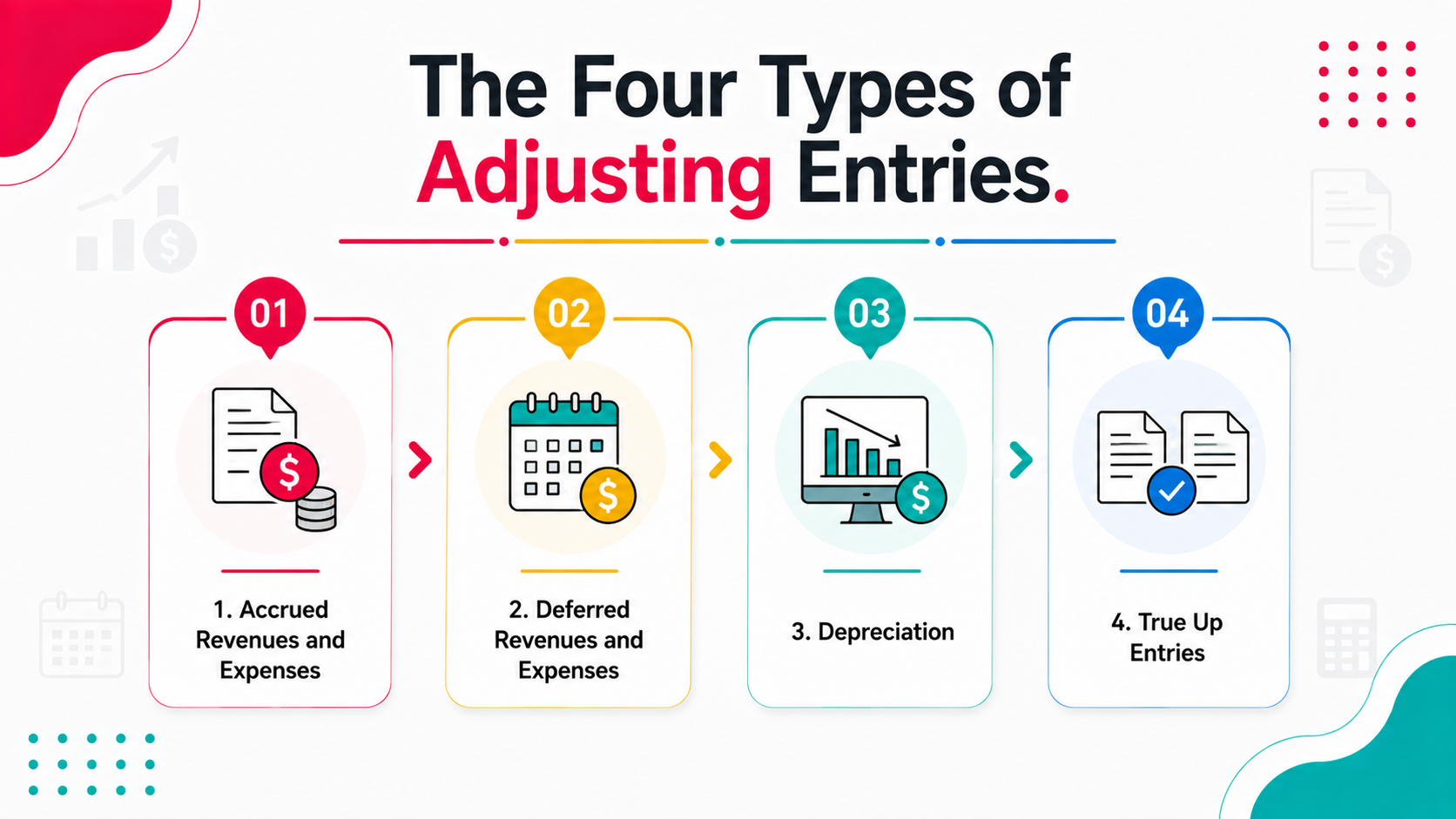
The four types of adjusting entries that feed the adjusted trial balance are accruals, deferrals, depreciation, and true ups.
1. Accrued Revenues and Expenses
Accruals record revenues earned or expenses incurred that have not yet been received or paid. Example: a client completes work in December but the invoice is not sent until January. The revenue is earned in December. An accrual records it in December even though the cash arrives in January. Without the accrual, December revenue is understated.
2. Deferred Revenues and Expenses
Deferrals delay recognition of revenue or expense to a future period when cash has already been received or paid. Example: a client pays $12,000 upfront for a year of services. Only $1,000 is earned in the first month. The remaining $11,000 is deferred to future periods. Without the deferral, first-month revenue is overstated.
3. Depreciation
Depreciation allocates the cost of a long-term asset across its useful life. Example: a $12,000 computer is depreciated over three years. The adjusting entry records $4,000 of depreciation expense per year. Without the depreciation entry, assets are overstated and expenses are understated.
4. True Up Entries
True up entries correct previously recorded estimates to match actual figures. Example: a utilities expense was accrued at $5,000 and the actual bill came in at $4,750. The true up entry corrects the $250 difference. For a full guide on true up entries, see our post on true up in accounting.
How to Prepare an Adjusted Trial Balance: Step by Step
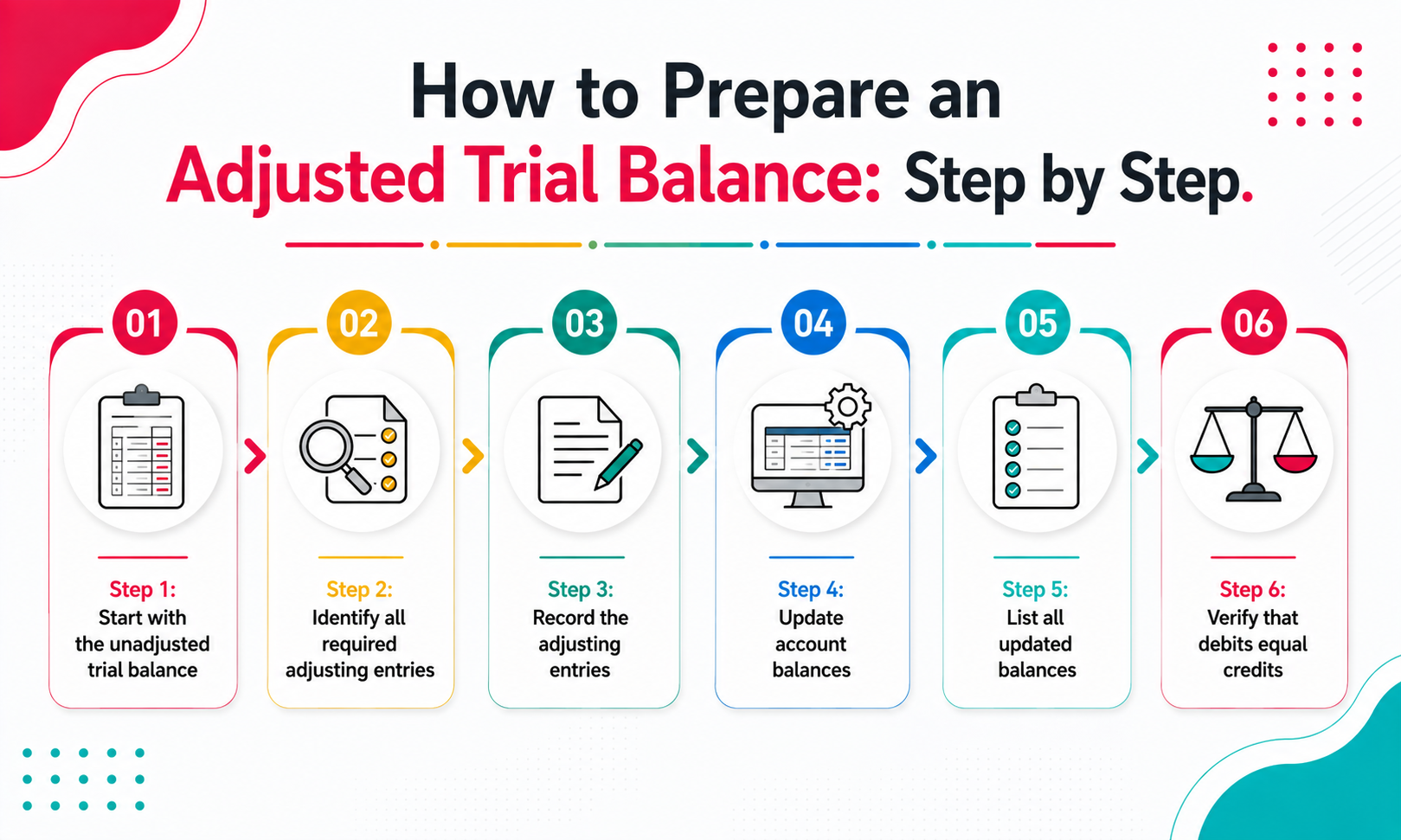
To prepare an adjusted trial balance, start with the unadjusted trial balance, record all adjusting entries, update each account balance for the adjustment, and verify that total debits equal total credits.
- Start with the unadjusted trial balance: list every account and its balance before adjusting entries. Confirm total debits equal total credits. If they do not, find and fix the error before proceeding.
- Identify all required adjusting entries: review the period for accrued revenues not yet billed, accrued expenses not yet invoiced, prepaid expenses to be recognized, deferred revenues to be allocated, depreciation for all fixed assets, and true up entries for any corrected estimates.
- Record the adjusting entries: for each entry, debit the account that is understated and credit the account that is overstated (or vice versa). Add a detailed memo to every adjusting entry explaining what is being adjusted and why.
- Update account balances: for each account affected by an adjusting entry, add to the debit balance if a debit entry, or add to the credit balance if a credit entry.
- List all updated balances: list every account with its post-adjustment balance.
- Verify that debits equal credits: add all debit balances, add all credit balances, and confirm they are equal. If they are not, find the error before proceeding to financial statement preparation.
Adjusted Trial Balance Example
Here is a simplified adjusted trial balance example for a small service business:
| Account | Debit | Credit |
|---|---|---|
| Cash | $12,500 | |
| Accounts Receivable | $8,200 | |
| Prepaid Insurance | $1,800 | |
| Equipment | $15,000 | |
| Accumulated Depreciation | $3,000 | |
| Accounts Payable | $4,100 | |
| Accrued Expenses | $1,200 | |
| Unearned Revenue | $2,000 | |
| Owner's Equity | $18,000 | |
| Service Revenue | $24,000 | |
| Insurance Expense | $1,200 | |
| Depreciation Expense | $1,500 | |
| Salaries Expense | $8,400 | |
| Utilities Expense | $1,700 | |
| Total | $50,300 | $50,300 |
Total debits equal total credits: $50,300. The adjusted trial balance is in balance. Financial statements can be prepared from these figures.
Common Errors in the Adjusted Trial Balance
The most common errors in the adjusted trial balance are unrecorded adjusting entries, transposition errors, missing accounts, and reconciliation discrepancies that were not resolved before close.
| Error Type | How It Shows Up | How to Fix |
|---|---|---|
| Unrecorded accrual | Revenue or expense missing from the period | Record the missing accrual and update the affected account |
| Transposition error | Debits and credits are off by a divisible-by-9 amount | Check all entry amounts for transposed digits |
| Missing account | An account with a balance is not in the trial balance | Add the account and its correct balance |
| Unreconciled account | A balance sheet account shows a balance that cannot be traced to a source document | Reconcile the account before close |
| True up not recorded | Actual figure differs from the accrual with no correction | Record the true up entry and update the balance |
Unreconciled accounts are the most common source of adjusted trial balance errors in client files. A bank account that has not been reconciled for six months has six months of unverified transactions flowing into the trial balance. The trial balance may appear to balance, but the balances are not verified. Xenett Pulse checks reconciliation status for every account before close. Any account that is stale or never reconciled is flagged immediately, with severity ranked so the most urgent issues are addressed first. Running Pulse before preparing the adjusted trial balance ensures all account balances are reconciled and verified before they flow into the trial balance.
A Common Situation We See
An accounting firm prepares the adjusted trial balance for a new client at year end. Total debits do not equal total credits. The difference is $3,750. The firm traces it to a depreciation adjusting entry that was recorded with the debit and credit transposed. Fixed easily. But then the partner reviews the trial balance more carefully. Three balance sheet accounts have balances that do not reconcile to any source document. The accounts were never reconciled during the year. The balances in the trial balance are unverified. Tracing them back requires reviewing 12 months of transactions manually.
After implementing Xenett Pulse as part of their pre-close process, the same firm now runs the diagnostic before preparing the adjusted trial balance. Any unreconciled accounts are surfaced immediately. The accounts are reconciled before the trial balance is prepared. The adjusted trial balance is built on verified balances. Year-end close time dropped significantly.
How Xenett Pulse Can Help
Xenett Pulse runs a 20-point diagnostic that checks every account's reconciliation status before the adjusted trial balance is prepared. The diagnostic surfaces accounts reconciled through period end (clean, ready to include), accounts stale over six months (need to be reconciled before close), accounts never reconciled (highest priority), cash discrepancies between QBO and actual bank balances, and transaction-level anomalies that may affect account balances. The Books Health Score (0 to 100) tells you the overall file health before close. Running Pulse before preparing the adjusted trial balance ensures every account balance flowing into the trial balance is reconciled and verified.
Sign up free and run your first diagnostic before your next period-end close. Or download a sample report to see what the output looks like.
Adjusted Trial Balance: At a Glance
| Element | Detail |
|---|---|
| What it is | List of all account balances after adjusting entries |
| When it is prepared | After unadjusted trial balance, before financial statements |
| What it confirms | Total debits equal total credits after all adjustments |
| What feeds it | Accruals, deferrals, depreciation, true up entries |
| Common errors | Unrecorded adjustments, transposition errors, unreconciled accounts |
| How to verify | Reconcile all accounts before preparing, confirm debit/credit equality |
Frequently Asked Questions
What is an adjusted trial balance?
An adjusted trial balance is a list of all account balances after adjusting entries have been recorded at period end. It is prepared after the unadjusted trial balance and before the financial statements. Its purpose is to verify that total debits equal total credits after all adjustments.
What is the difference between an adjusted and unadjusted trial balance?
The unadjusted trial balance lists balances before period-end adjusting entries. The adjusted trial balance lists balances after all accruals, deferrals, depreciation, and true up entries have been recorded. Financial statements are prepared from the adjusted trial balance.
How do you prepare an adjusted trial balance?
Start with the unadjusted trial balance. Record all adjusting entries. Update each affected account balance. List all accounts with post-adjustment balances. Verify that total debits equal total credits.
What are the four types of adjusting entries?
Accrued revenues and expenses, deferred revenues and expenses, depreciation, and true up entries. Each type corrects or allocates amounts that were not captured by regular transaction recording during the period.
What happens if debits and credits do not equal on the adjusted trial balance?
Find the error before proceeding to financial statement preparation. Common causes: a transposition error in an entry amount, a missing entry, an entry recorded to the wrong account, or an unreconciled account with an incorrect balance.
What accounts appear on the adjusted trial balance?
All accounts in the general ledger: assets, liabilities, equity, revenue, and expenses. Each account appears once with its post-adjustment balance, listed as either a debit or credit.
How does the adjusted trial balance relate to the financial statements?
The financial statements are prepared directly from the adjusted trial balance. The P&L uses the revenue and expense accounts. The balance sheet uses the asset, liability, and equity accounts. If the adjusted trial balance is wrong, the financial statements will be wrong.
Related guides
- Start here: QuickBooks Cleanup: The Complete Guide
- True Up in Accounting — What a true-up entry is and when a cleanup calls for one.
- QuickBooks Online Cleanup Checklist — The step-by-step checklist to work through a QBO cleanup in order.
- QuickBooks Cleanup Checklist Before You Quote — The checklist to run before you quote, so scope is known up front.
.avif)