


.avif)
Blog Summary
- A bookkeeping proposal wins clients when it is specific, evidence-based, and clearly scoped.
- The most common proposal mistake: writing the scope before assessing the file.
- A strong proposal has six sections: overview, scope, fee, timeline, exclusions, and next steps.
- Xenett Pulse runs a pre-engagement diagnostic in under two minutes so the scope is built from evidence.
Most bookkeeping proposals look the same.
A brief introduction.
A list of services.
A monthly fee.
A call to action.
The client signs.
Work starts.
Three weeks later the scope is double what was proposed because the books were in worse shape than anyone described.
The proposal was not the problem.
The problem was that the scope section was written before anyone checked the actual state of the books.
A strong bookkeeping proposal is not just a formatted document.
It is a scoped, evidence-based commitment that reflects the actual work.
This guide covers what goes into each section, how to write the scope from diagnostic evidence rather than client description, and a free template you can customize and send today.
Part of our complete guide: guide to pricing bookkeeping services
What Makes a Bookkeeping Proposal Win Clients
A bookkeeping proposal wins clients when it is specific, clearly scoped, and priced from evidence. A vague proposal loses on price. A specific proposal wins on trust.
Most prospects are comparing multiple proposals.
A proposal that says monthly bookkeeping services: $X/month looks the same as every other proposal.
A proposal that says we reviewed your QuickBooks file and found three accounts stale by nine months, 180 duplicate transactions, and $14,000 in unapplied AR payments, here is what we will do and what it will cost, stands apart.
The second proposal demonstrates that the firm knows what it is walking into.
It shows the client exactly what they are paying for.
It builds trust before the engagement starts.
According to data from Xenett Pulse, 68% of engagements start with unvalidated books.
Firms that run a pre-engagement diagnostic and use the findings in their proposal are in the 32% that scope and price accurately from day one.
Stop Absorbing Catch-Up Overruns
Run a 20-point Xenett Pulse diagnostic in under 2 minutes and quote from evidence, not estimation.
Sign Up FreeKnow What's in the File Before You Quote
Xenett Pulse surfaces every reconciliation gap, duplicate, and error in under 2 minutes.
Sign Up FreePrice Every Catch-Up Engagement with Confidence
Xenett Pulse gives you a documented file assessment before the proposal conversation.
The Six Sections of a Strong Bookkeeping Proposal
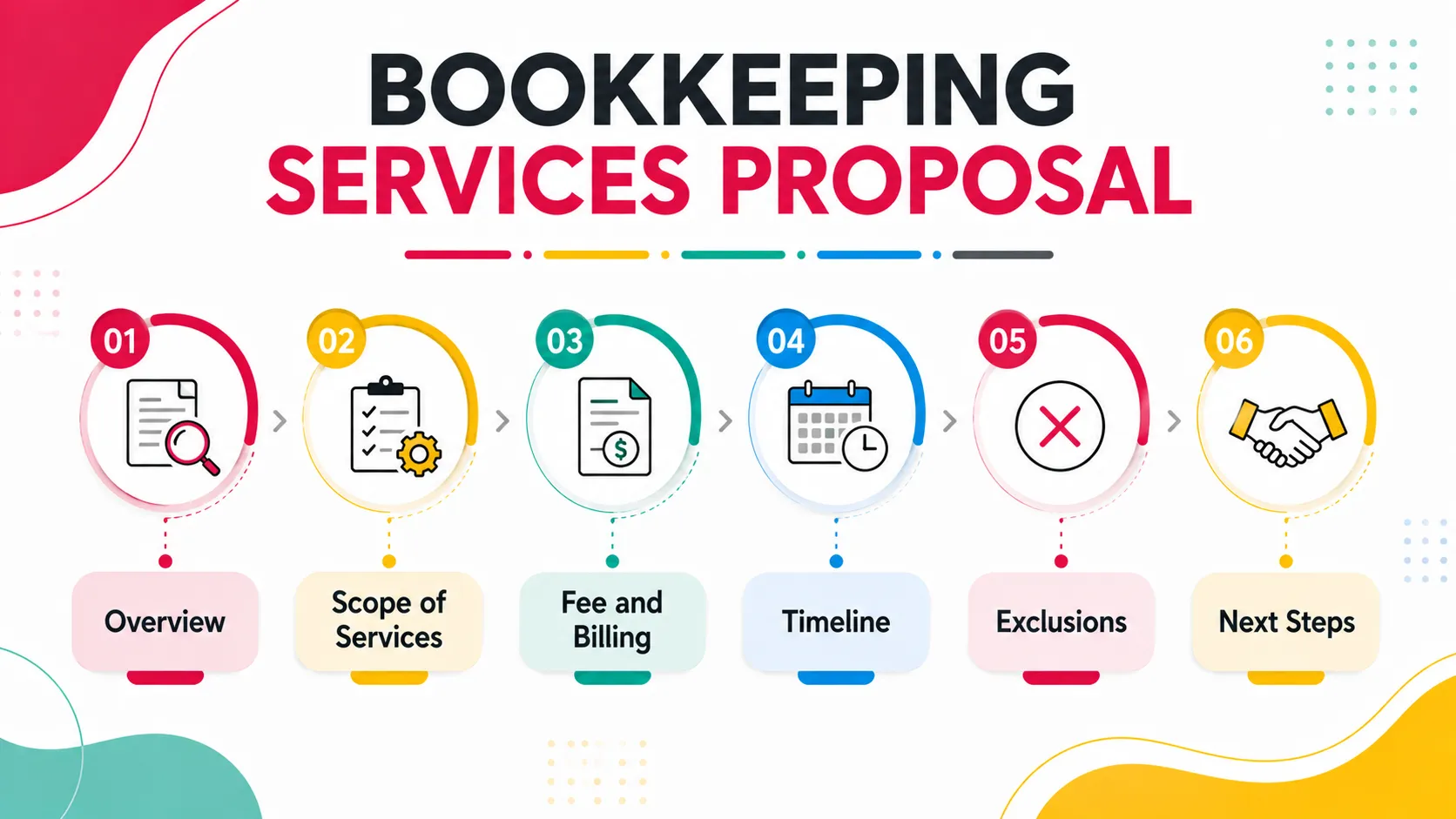
A complete bookkeeping proposal has six sections: overview, scope of services, fee and billing, timeline, exclusions, and next steps.
| Section | Purpose | Common Mistake |
|---|---|---|
| Overview | Set context: what you found, what you will do | Too generic, no file-specific detail |
| Scope of Services | Specific task list based on diagnostic findings | Written as a category, not a task list |
| Fee and Billing | Fixed fee or phased pricing with billing terms | Set without knowing the file condition |
| Timeline | Start date, Phase 1 completion, first monthly deliverable | Omitted entirely |
| Exclusions | Explicit list of what is not covered | Skipped: leads to scope disputes |
| Next Steps | Clear call to action | Vague: let me know if you have questions |
How to Write the Scope Section From Evidence
Write the scope section after running a pre-engagement diagnostic, not before. The diagnostic findings become the evidence layer behind every line in the scope.
This is the most important section and the most commonly written wrong.
A scope written from a client description:
We will provide monthly bookkeeping services including bank reconciliations, transaction categorization, and monthly financial statements.
A scope written from a Xenett Pulse diagnostic:
Phase 1: Cleanup (one-time): Reconcile accounts X, Y, Z from January 2024 through present. Remove 180 duplicate transactions identified in the pre-engagement review. Apply 22 unapplied payments in AR. Resolve nine-month reconciliation backlog on savings account. Estimated completion: 3 weeks. Phase 2: Ongoing Monthly Bookkeeping: Reconcile all accounts monthly, categorize all transactions, deliver P&L and balance sheet by the 10th of the following month. Monthly fee: $X/month.
The second version tells the client exactly what is being done, why, and what it will cost.
There is no ambiguity.
There is no room for I thought that was included.
Xenett Pulse runs a 20-point diagnostic on the client's QuickBooks file in 1 minute 42 seconds.
The output is a Books Health Score (0 to 100) and a ranked list of every issue across banking, AR, AP, reconciliations, and coding.
That output feeds directly into the scope section.
The Exclusions Section: Do Not Skip It
The exclusions section prevents scope creep. List every service not included, explicitly, so the client cannot assume it is covered.
Common exclusions for a bookkeeping proposal:
- Tax preparation and filing
- Payroll processing
- CFO or financial advisory services
- Historical cleanup prior to the engagement start date (if not in scope)
- Accounts payable management (if not in scope)
- Inventory management
- Multi-entity consolidation
Also include an out-of-scope billing clause:
Work outside the defined scope will be billed at $[X] per hour. Out-of-scope work requires written approval before it begins.
This clause sets the rate before any dispute arises and creates a documented approval process for scope changes.
Free Bookkeeping Proposal Template
Use this template as a starting point. Customize the bracketed fields for each client.
BOOKKEEPING SERVICES PROPOSAL
Prepared by: [Your Firm Name]
Prepared for: [Client Business Name]
Date: [Date]
Valid until: [30 days from date]
1. Overview
[Your Firm Name] has reviewed your QuickBooks file and prepared this proposal based on the current state of your books.
Pre-engagement findings: [Insert 2 to 3 key findings from Xenett Pulse diagnostic, e.g., Three bank accounts have not been reconciled since January 2024. We identified 180 duplicate transactions from a prior import. Accounts receivable includes 22 unapplied payments totaling $14,200.]
This proposal outlines a two-phase engagement: an initial cleanup to bring the books current, followed by ongoing monthly bookkeeping to maintain accuracy going forward.
2. Scope of Services
Phase 1: Cleanup (One-Time)
- Reconcile [list accounts] from [start date] through [end date]
- Remove [X] duplicate transactions identified in pre-engagement review
- Apply [X] unapplied payments in accounts receivable
- Resolve reconciliation backlog on [specific accounts]
- Correct miscoded transactions in [categories] identified in diagnostic
Estimated completion: [X] weeks from engagement start.
Phase 2: Ongoing Monthly Bookkeeping
- Reconcile [list accounts] monthly
- Categorize all transactions in QuickBooks Online
- Prepare monthly profit and loss statement and balance sheet
- Deliver financial package by the [X]th of the following month
3. Fee and Billing
Phase 1: Cleanup: $[Amount] (one-time, invoiced in [X] milestones)
Phase 2: Ongoing Monthly Bookkeeping: $[Amount]/month, billed on the [1st/15th]
Payment due within [15/30] days of invoice.
Out-of-scope work: $[Hourly Rate]/hour, requires written approval before work begins.
4. Timeline
Engagement start date: [Date]
Phase 1 completion: [Date]
First monthly deliverable: [Date]
5. Exclusions
The following services are not included unless agreed separately:
- Tax preparation or filing
- Payroll processing
- CFO or financial advisory services
- [Any other relevant exclusions]
6. Next Steps
Reply to confirm acceptance of this proposal. We will issue a formal engagement letter for signature before work begins. Questions: contact [Name] at [Email/Phone].
This proposal is valid for 30 days from the date above.
Know What's in the File Before You Quote
Xenett Pulse surfaces every reconciliation gap, duplicate, and error in under 2 minutes.
Sign Up FreeA Common Situation We See
A bookkeeping firm sends a standard two-page proposal to every new prospect.
Same template.
Same service description.
Same monthly fee range.
A competitor firm sends a proposal that includes three specific findings from a pre-engagement diagnostic, a two-phase scope, and a cleanup fee based on documented evidence.
The prospect chooses the second firm.
Not because the fee was lower.
Because the proposal showed the firm knew exactly what it was walking into.
After adding Xenett Pulse to their pre-proposal process, the first firm now runs the diagnostic on every new prospect file before the proposal call.
The findings from Pulse go into the overview and scope sections.
The proposal looks different from every competitor.
Close rate on new proposals increased significantly.
How Xenett Pulse Can Help
Xenett Pulse is the tool that makes the scope section of your proposal specific and evidence-based.
Connect the prospect's QuickBooks file and Pulse runs a 20-point diagnostic in 1 minute 42 seconds.
The output is a Books Health Score (0 to 100), ranked risk areas across banking, AR, AP, reconciliations, and coding, and transaction-level findings that show exactly what is wrong and how severe each issue is.
Those findings go directly into the overview and scope sections of the proposal.
The report is white-labelled and client-ready as a PDF from day one.
You can share it with the prospect during the proposal call as supporting evidence for the cleanup scope and fee.
68% of engagements start with unvalidated books. Firms that run Pulse before the proposal are in the 32% that scope accurately from day one.
Sign up free and run your first diagnostic before your next proposal goes out.
Frequently Asked Questions
What should a bookkeeping proposal include?
Six sections: overview, scope of services, fee and billing, timeline, exclusions, and next steps. The scope section should be a specific task list based on diagnostic findings, not a general service description.
How do I write a bookkeeping proposal that wins clients?
Run a pre-engagement diagnostic on the client's file. Use the findings in the overview and scope sections. Price in two phases: cleanup and ongoing. Include an explicit exclusions section. Make the next steps clear.
What is the difference between a bookkeeping proposal and an engagement letter?
The proposal is the sales document: it outlines scope, fee, and timeline for the client to review and accept. The engagement letter is the formal agreement: it includes legal terms, client responsibilities, and signatures from both parties. The proposal comes first. The engagement letter follows once the proposal is accepted.
How long should a bookkeeping proposal be?
One to three pages for most engagements. The scope section will be longer for complex cleanups. Specificity matters more than length.
How do I price a bookkeeping proposal accurately?
Run a pre-engagement diagnostic before writing the proposal. Use the findings to estimate cleanup hours, build Phase 1 pricing, and set the ongoing monthly fee based on clean books.
Can I show the pre-engagement diagnostic to the client in the proposal?
Yes. Xenett Pulse generates white-labelled, client-ready PDF reports from day one. Sharing the diagnostic findings with the prospect demonstrates that your proposal is evidence-based, which builds trust and supports the cleanup fee.
How do I prevent scope creep after the proposal is accepted?
Include an explicit exclusions section in the proposal. Add an out-of-scope billing clause with your hourly rate and a written approval requirement. Issue a formal engagement letter for signature before work begins.
Price Every Catch-Up Engagement with Confidence
Xenett Pulse gives you a documented file assessment before the proposal conversation.
Conclusion
A bookkeeping proposal is not just a formatted document. It is the first demonstration of how your firm works.
A vague proposal says you quote the same as everyone else.
A specific, evidence-based proposal says you did the work before the call.
You know what is in the books.
You priced from what you found.
That is the proposal that wins the client and protects the engagement.
Related guides
- Start here: How to Price Bookkeeping Services
- Accounting Services Proposal Template — A broader accounting services proposal template for firms.
- Why Bookkeeping Scope Creep Happens — Why scope creep happens on cleanup work, and how to price around it.
- Bookkeeping Mistakes That Blow Up Fixed Fees — The bookkeeping mistakes that blow up a fixed fee.
Run a free Xenett Pulse diagnostic before your next proposal and write the scope from evidence, not estimation.


.avif)