


Blog Summary
- Reconciliation problems are the most common hidden cost in fixed-fee bookkeeping engagements.
- They are invisible in summary reports and only surface after the engagement has started.
- 68% of engagements start with unvalidated books, and the average scope expansion is 3x.
- The fix is a pre-engagement diagnostic that surfaces reconciliation gaps before scope and pricing are locked.
- Xenett Pulse runs a full reconciliation check across all accounts in under two minutes.
You quote a fixed fee for a new bookkeeping client.
The books look reasonable.
The client says everything is mostly current.
You start the engagement.
Two weeks in, you find three bank accounts that have not been reconciled in over a year.
One has a disconnected feed.
Another has a forced adjusting entry masking a $2,400 discrepancy from eight months ago.
The fixed fee you quoted does not cover any of this.
You absorb it.
This is not a client management problem.
It is a scoping problem.
And it starts the moment a fixed-fee proposal is written without knowing the actual state of the books.
Part of our complete guide: guide to reconciling in QuickBooks Online
Why Reconciliation Problems Stay Hidden Until It Is Too Late
Reconciliation problems are invisible in standard QuickBooks reports. A balance sheet can balance, a P&L can look normal, and the books can still have months of unreconciled accounts underneath.
This is the core problem with every pre-engagement review that relies on summary reports.
The numbers appear in order.
Reports generate without error messages.
Everything looks like it is in place.
Underneath, accounts have not been reconciled in months.
Bank feeds disconnected without anyone noticing.
Forced adjusting entries closed prior periods without resolving the actual discrepancy.
None of that shows up in a P&L or balance sheet.
It only becomes visible when someone checks the reconciliation status of every account directly.
By the time that happens, the engagement letter is signed and the fee is fixed.
According to data from Xenett Pulse, 68% of engagements start with unvalidated books.
The average scope expansion after discovery is 3x.
That gap, between the proposed fee and the actual work, comes directly from reconciliation problems that were already in the file before the engagement began.
The Three Reconciliation Problems That Cost Firms the Most
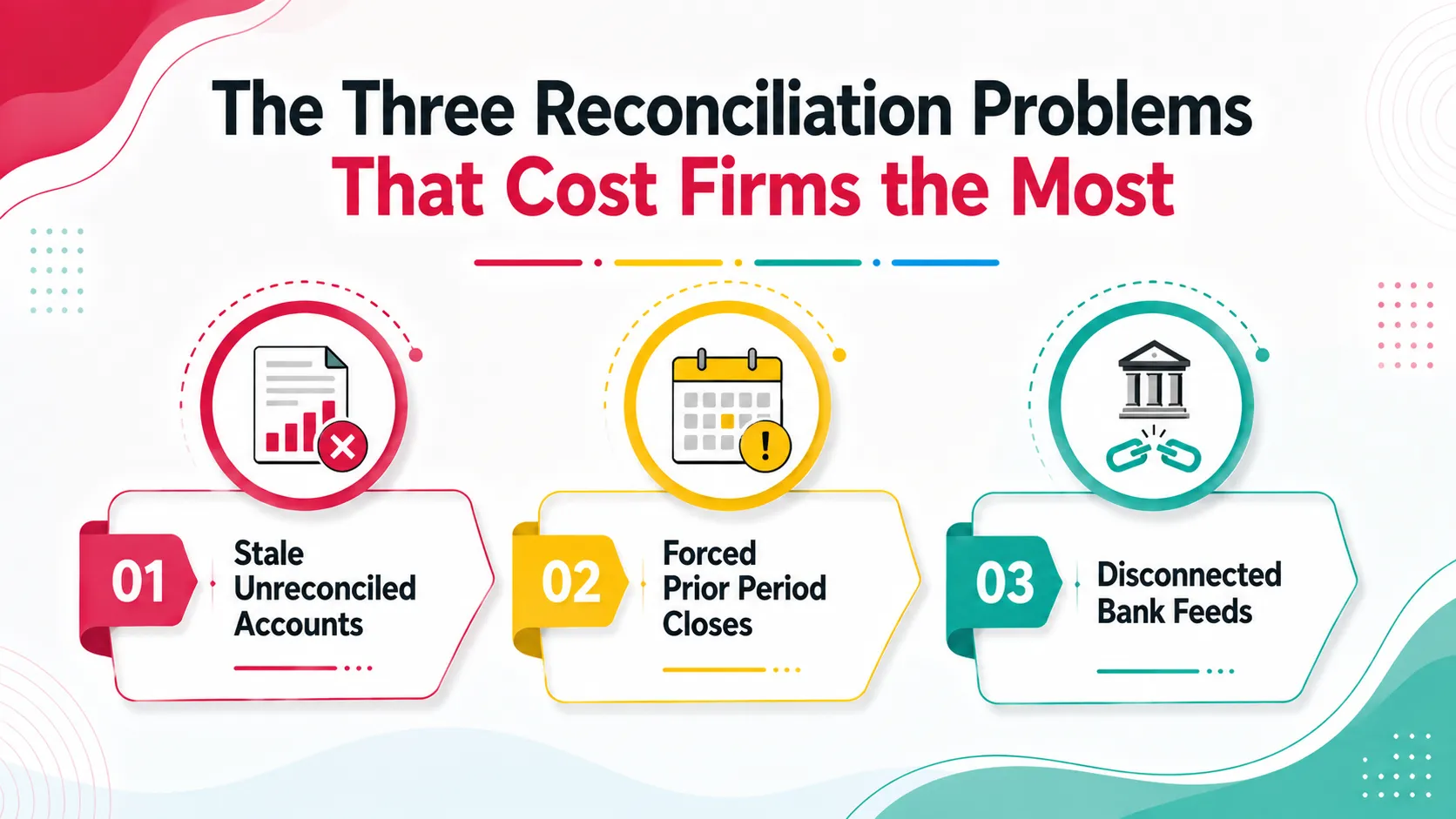
The three reconciliation problems that most commonly blow up fixed-fee engagements are: stale unreconciled accounts, forced prior period closes, and disconnected bank feeds.
Each one compounds silently.
Each one is invisible in standard reports.
Each one adds significant unplanned work to the engagement.
1. Stale Unreconciled Accounts
An account that has not been reconciled in six months or more is not just behind.
It is a backlog of unverified transactions, potential duplicates, and unknown discrepancies stacked on top of each other.
The longer it goes, the harder it is to close.
A one-month reconciliation backlog might take two hours to resolve.
A twelve-month backlog on an active account can take twenty hours or more, depending on transaction volume and whether source documents are available.
When this shows up after an engagement starts, it is rarely part of the quoted scope.
2. Forced Prior Period Closes
This is the most insidious reconciliation problem.
A prior bookkeeper could not get a reconciliation to close cleanly.
Instead of finding the root cause, they added a small journal entry to force the difference to zero.
The period closed.
The error was masked.
Next month, the same thing happened.
Six months of forced entries later, the file has six layers of masked errors stacked on top of each other.
The current period reconciliation will not close cleanly because it is inheriting discrepancies from every prior period.
Tracing them back requires reopening and re-reconciling multiple periods.
What looked like a straightforward monthly bookkeeping engagement is now a multi-month forensic reconciliation project.
3. Disconnected Bank Feeds
A bank feed that stops importing transactions does not generate an error in QuickBooks reports.
The QBO balance just stops updating.
If nobody notices for three months, three months of transactions are missing from the file.
When the reconciliation runs, the transaction set is incomplete.
The reconciliation cannot close because the transactions on the bank statement are not in QBO.
Every missing transaction needs to be manually entered or re-imported.
For a high-volume account, that is hours of data entry work that was not in the quoted scope.
What These Problems Cost on a Fixed-Fee Engagement
Each of these three problems adds unplanned hours to a fixed-fee engagement. The combined impact is typically a 2x to 3x scope expansion on the reconciliation work alone.
Here is a realistic impact estimate per problem:
| Problem | Impact on Fixed-Fee Scope |
|---|---|
| Stale account (6 months) | 8 to 15 additional hours depending on volume |
| Stale account (12+ months) | 20 to 40 additional hours |
| Forced prior period entries (3 to 6 months) | 5 to 15 hours to trace and re-reconcile |
| Disconnected bank feed (3 months) | 3 to 10 hours to import and match missing transactions |
| All three on one file | 30 to 60+ hours of unplanned work |
A fixed fee that was priced at $1,500 for monthly bookkeeping can easily require $4,000 to $6,000 worth of work if all three problems are present.
The margin is gone before the first monthly deliverable goes out.
How to Find Reconciliation Problems Before You Quote
Run a pre-engagement diagnostic on every client file before writing the proposal. The diagnostic surfaces all three reconciliation problems in under two minutes.
This is the step that eliminates the scope overrun.
Not after the engagement letter is signed.
Not after work starts.
Before the proposal is written.
Xenett Pulse connects to the client's QuickBooks file and runs a 20-point diagnostic in 1 minute 42 seconds.
The reconciliation check covers every account and returns one of three statuses:
- Reconciled through period end: account is current and clean
- Stale over six months: account has fallen behind and needs catch-up work
- Never reconciled: account has no reconciliation history
Critical issues are flagged instantly: unreconciled accounts, duplicate transactions, and cash discrepancies are surfaced and ranked by severity.
The output is a Books Health Score from 0 to 100.
A low score on the reconciliation category tells you the scope includes significant catch-up work before monthly bookkeeping can even start.
That information changes the proposal completely.
Instead of quoting a flat monthly fee, you quote:
- Phase 1: Reconciliation catch-up (one-time, priced from the diagnostic findings)
- Phase 2: Ongoing monthly bookkeeping (monthly fee, based on clean books)
The client understands what they are paying for.
The fee reflects the actual work.
The margin holds.
How to Use the Diagnostic Findings in Your Proposal
Map each reconciliation finding directly to a line in the scope section of your proposal. The diagnostic output is the evidence layer behind your fee.
Here is how to convert findings into scope language:
Instead of: Monthly bookkeeping services: $X/month
Write: Phase 1: Reconcile accounts X, Y, Z from January 2024 through present. Address disconnected bank feed on account Y covering March through June 2024. Resolve prior period reconciliation discrepancies in account Z. Estimated completion: 4 weeks. Fee: $X (one-time). Phase 2: Ongoing monthly bookkeeping: $X/month.
Every finding from the Pulse diagnostic becomes a specific line in the scope.
No ambiguity.
No room for I thought that was included.
No margin erosion after the engagement starts.
A Common Situation We See
A bookkeeping firm quotes $950/month for a new retail client.
The proposal is written after a 20-minute call and a quick look at the QBO balance sheet.
No diagnostic is run.
Work starts.
Week two: two bank accounts stale by nine months each.
Week three: a disconnected Shopify feed with seven months of missing transactions.
Week four: four prior period forced entries masking a $3,100 cumulative discrepancy.
The firm spends 38 hours on reconciliation work before the first monthly deliverable goes out.
At their hourly rate, that is $3,800 of unplanned work on a $950/month engagement.
After adding Xenett Pulse to their pre-proposal process, the same firm now runs the diagnostic before every prospect call.
The reconciliation findings from Pulse become Phase 1 of every proposal.
The monthly fee starts only after Phase 1 is complete and the books are clean.
Scope overruns on reconciliation work dropped to zero.
Stop Absorbing Catch-Up Overruns
Run a 20-point Xenett Pulse diagnostic in under 2 minutes and quote from evidence, not estimation.
Sign Up FreeHow Xenett Pulse Can Help
Xenett Pulse runs the full reconciliation check, and 19 other diagnostic checks, in 1 minute 42 seconds.
The output covers:
- Reconciliation status for every account (current, stale, never reconciled)
- Cash discrepancies between QBO and bank balances
- Duplicate transactions that will compound during reconciliation
- Disconnected bank feeds and gap periods
- Banking anomalies flagged by GPT-powered pattern detection
The findings are ranked by severity: urgent, compounding, or safe to monitor.
The report is white-labelled and client-ready.
You can share it directly with the prospect as the basis for your Phase 1 scope conversation.
68% of engagements start with unvalidated books. Running Pulse before the proposal puts your firm in the other 32%.
Sign up free and run your first diagnostic before your next proposal goes out.
Know What's in the File Before You Quote
Xenett Pulse surfaces every reconciliation gap, duplicate, and error in under 2 minutes.
Sign Up FreeFrequently Asked Questions
Why do fixed-fee bookkeeping engagements go over scope?
The most common reason is reconciliation problems that were not identified before the engagement was priced. Stale accounts, disconnected bank feeds, and forced prior period entries all add significant unplanned hours to an engagement. Running a pre-engagement diagnostic surfaces all of these before the fee is set.
How do I find reconciliation problems in a client's QuickBooks file?
Standard reports do not surface reconciliation status. You need to check each account directly for its reconciliation history, or run a diagnostic tool like Xenett Pulse that checks all accounts automatically in under two minutes.
What is the average scope expansion on a bookkeeping cleanup engagement?
According to data from Xenett Pulse, the average scope expansion after discovery is 3x. 68% of engagements start with unvalidated books, meaning the scope and fee were set without a full picture of the file condition.
How should I price a fixed-fee bookkeeping engagement?
Price in two phases: a one-time catch-up or cleanup phase based on the diagnostic findings, and an ongoing monthly phase based on clean books. Never price a fixed monthly fee on a file you have not assessed.
What does a reconciliation diagnostic check?
A reconciliation diagnostic checks the status of every bank and credit card account: whether it is reconciled through period end, stale over six months, or never reconciled. It also surfaces cash discrepancies, disconnected bank feeds, and duplicate transactions that will affect the reconciliation.
How long does a pre-engagement file diagnostic take?
Xenett Pulse runs a full 20-point diagnostic in 1 minute 42 seconds.
What is a Books Health Score?
A Books Health Score is a 0 to 100 rating of a QuickBooks file's overall health across reconciliation, data quality, and accuracy. A lower score means more cleanup work is needed before monthly bookkeeping can begin.
Conclusion
Reconciliation problems are not the client's fault.
They are the natural result of books that were managed without a consistent review process.
They are also not visible until someone looks for them.
The standard pre-engagement review does not look for them.
The diagnostic does.
Run it before every proposal.
Price from what it surfaces.
Protect the margin before the engagement starts.
Related guides
- Start here: How to Reconcile in QuickBooks Online
- How to Undo a Reconciliation in QuickBooks Online — When to undo a reconciliation, and how to do it safely.
- Fix Reconciliation Discrepancies in QBO — How to trace and clear a reconciliation discrepancy in QBO.
- What Unreconciled Accounts Really Cost — What unreconciled accounts actually cost a client and a firm.
Run a free Xenett Pulse diagnostic on your next prospect file and see the full reconciliation picture before the proposal goes out.